
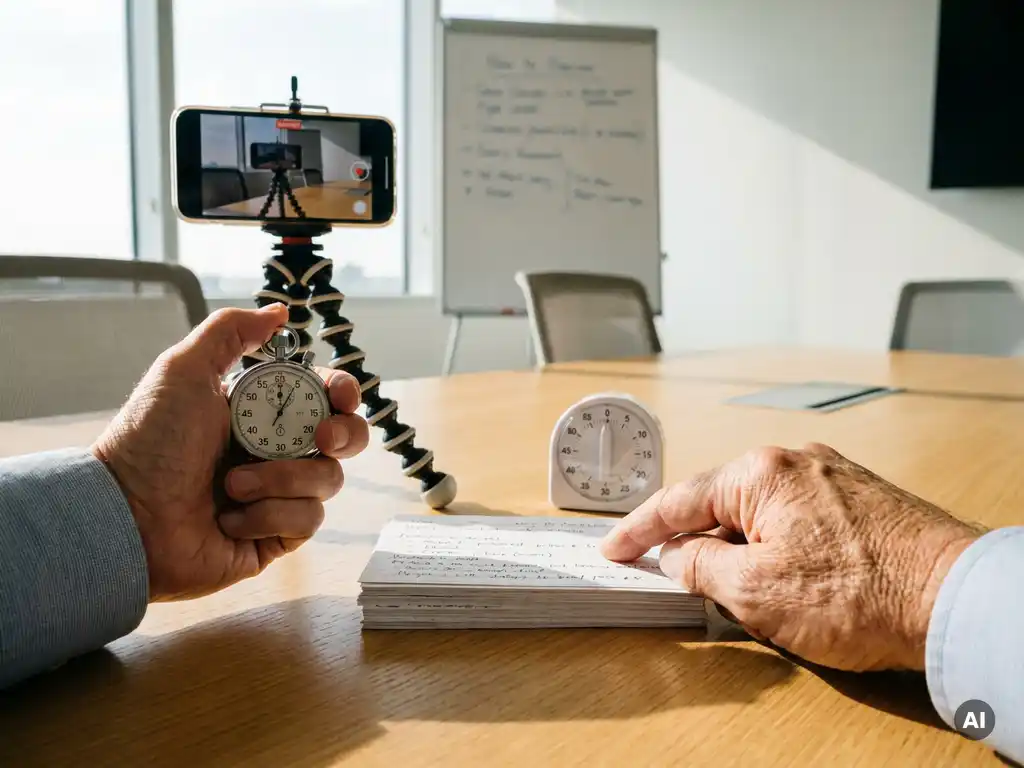
A strong 60-second pitch training program works best when you build a repeatable structure, drill it with timed practice, and coach delivery until the message lands clearly under pressure. Structure training around a simple hook-to-value-to-proof-to-ask flow, then rehearse it in short, high-feedback cycles.
This approach fits leaders, sales teams, and internal change champions who need to cut through information overload and make a message memorable fast. The key is to train both content and performance, not just wording.
The questions below break down the 60-second rule, elevator pitch structure, pitch coaching exercises, and a practical pitch practice framework you can run with any team.
What is the 60-second rule in pitch training?
The 60-second rule in pitch training is the discipline of communicating one clear idea in under a minute, using only the details that move a listener from attention to understanding to action. It forces prioritization, sharper language, and stronger delivery so a pitch stays memorable even when audiences feel distracted or overloaded.
In practice, the rule is less about speed and more about focus. You choose a single goal for the pitch, then remove anything that does not support that goal. That is why 60-second pitch training often improves longer presentations too, because it reveals what the real message is.
Use the 60-second rule when you need to:
- Introduce yourself or your team in a meeting
- Pitch a project internally to leadership or stakeholders
- Explain a change initiative without losing people in details
- Start a sales conversation with a clear next step
How do you structure a 60-second pitch from hook to close?
To structure a 60-second pitch, use a simple elevator pitch structure: a hook that earns attention, a clear value statement, one proof point, and a specific close that asks for a next step. This format keeps storytelling in business pitches tight while still giving the listener a reason to care and act.
A practical timing split that works for most teams is:
- Hook (10 to 15 seconds): name the problem, tension, or surprising truth your audience recognizes
- Value (15 to 20 seconds): what you do and for whom, in plain language
- Beweis (10 to 15 seconds): one concrete example, result, or credible detail that reduces doubt
- Close (10 to 15 seconds): a clear ask, meeting, intro, pilot, decision, or question
Keep the hook specific. Instead of a broad claim, use a moment your audience has lived through. For internal pitches, that might be a familiar friction point between departments. For change communication, it might be the confusion people feel when messages arrive through too many channels.
For storytelling in business pitches, add one micro-story beat in the proof section: a before moment, the turning point, and the after. You do not need a full narrative arc. You need just enough to make the value feel real.
Which exercises build 60-second pitch skills fastest?
The fastest pitch coaching exercises combine tight constraints, repetition, and immediate feedback. The best drills force clarity first, then add delivery skills like pacing, emphasis, and presence. A good pitch practice framework uses short rounds, clear scoring criteria, and progressive difficulty so people improve in minutes, not weeks.
- One-sentence core: reduce the pitch to one sentence that includes audience, problem, and value
- 15 30 60 ladder: deliver the same pitch in 15 seconds, then 30, then 60 without adding fluff
- Hook swap: write three different hooks for the same pitch and test which earns attention fastest
- Proof point roulette: prepare three proof options and choose one on the spot to build flexibility
- Question close: end with a single question that invites the next step, then refine until it feels natural
If you want delivery gains quickly, add performance constraints:
- Speak slower than feels normal and cut filler words
- Pause once after the hook and once before the ask
- Use one intentional gesture and one intentional change in tone
Improvisation-style drills also help because they train listening and adaptability. Teams that learn to respond in the moment tend to sound more human and less scripted, which is crucial when audiences are skeptical or fatigued.
How do you give feedback and measure progress in 60-second pitch training?
Give feedback in 60-second pitch training by scoring the pitch against a small set of observable criteria, then coaching one change at a time. Measure progress with timed recordings, listener recall tests, and consistent rubrics that track clarity, structure, and delivery. This keeps feedback objective and makes improvement visible.
A simple rubric that works across roles includes:
- Klarheit: can a listener repeat the main point in one sentence?
- Relevanz: does the pitch speak to the audience’s problem, not the speaker’s features?
- Aufbau: is the elevator pitch structure obvious from hook to close?
- Beweis: is there one credible detail that reduces doubt?
- Fragen: is the next step specific and easy to say yes to?
- Lieferung: pace, pauses, pronunciation, and confidence
For measurement, use two quick checks after each round:
- 10-second playback: ask listeners what they remember most. If they recall the wrong thing, the pitch needs refocusing.
- Next-step readiness: ask whether the close made them want to take the next step, and why.
Keep feedback tight. One strength, one priority fix, one rerun. That rhythm prevents overwhelm and builds momentum, especially for teams already dealing with heavy communication loads.
What common mistakes ruin a 60-second pitch and how do you fix them?
The most common mistakes in a 60-second pitch are trying to say too much, leading with generic claims, and ending without a clear ask. Fix them by choosing one audience and one goal, using a concrete hook, adding a single proof point, and closing with a specific next step. Simplicity beats completeness.
Here are the failures that show up most often, plus practical fixes:
- Feature-Dumping: listing everything you do. Fix: state one outcome you create and for whom.
- Vague hook: starting with mission statements. Fix: open with a recognizable problem moment.
- No proof: asking for trust without support. Fix: add one concrete example, number, or observable result you can stand behind.
- Multiple audiences: trying to please everyone. Fix: pick the decision-maker you want and tailor language to them.
- Weak close: ending with thanks instead of direction. Fix: ask for a meeting, intro, pilot, or decision.
- Rushed delivery: speaking fast to fit time. Fix: cut words, not pauses. Pauses increase authority.
If the pitch still feels crowded, remove one idea and test again. A 60-second pitch training mindset treats every extra sentence as a cost to attention.
Wie unterstützt „Boom For Business“ beim Training für 60-Sekunden-Pitches?
We help teams master 60-second pitch training by combining message clarity coaching with performance techniques from improvisation and storytelling, so pitches sound confident, human, and easy to remember. We act as a sparring partner to find the true message, then build a repeatable pitch practice framework your team can keep using.
- Botschaft präzisieren so the core idea lands fast and clean
- Elevator pitch structure templates tailored to your audience and goal
- Pitch coaching exercises that build timing, presence, and flexibility under pressure
- Storytelling in business pitches so complex ideas become simple, relatable, and actionable
- Teamzusammenstellung so different departments tell the same story with one voice
Erfahren Sie mehr über unseren Ansatz unter Aufschwung für die Wirtschaft, oder sehen Sie sich die Optionen für interaktive Workshops, Teambuilding-Formate, and building a positive Kultur. If you want a pitch training plan that fits your event, leadership offsite, or change program, reach out and we will design the right format together.
Häufig gestellte Fragen
How do I tailor a 60-second pitch for different audiences without rewriting everything?
Keep one “core” pitch (problem + value + proof) and swap only three variables: the audience label (who it’s for), the pain point (what they care about), and the ask (what you want from them). Create a small matrix with 2–3 audience types and pre-write one hook and one close for each so you can adapt in minutes, not hours.
What should I do if I don’t have strong metrics or case studies for the proof point?
Use “credible specifics” instead of big numbers: a concrete example, a short before/after, a named constraint you removed, or a process change that produced an observable result (fewer handoffs, faster approvals, fewer errors). If you must use a number, use a range you can defend and explain how you measured it.
How can I make the close feel natural instead of salesy?
Turn the close into a low-friction next step that matches the listener’s risk level. Examples: “Is it worth a 15-minute call to see if this fits?” “Who else should be in the room?” or “Would a small pilot with one team be useful?” If you feel pushy, your ask is probably too big for a first conversation—shrink it.
How often should a team practice 60-second pitches, and what does a simple weekly routine look like?
Aim for 10–15 minutes, 2–3 times per week. A simple routine: (1) one timed run, (2) one piece of feedback using the rubric (clarity/proof/ask), (3) one immediate rerun. Record one round per week to track progress and keep the standard consistent across the team.
What’s the best way to handle interruptions or tough questions during a 60-second pitch?
Acknowledge, bridge, and return: acknowledge the question (“Good point”), bridge with a short answer or a promise to follow up (“In one line…”), then return to your structure (“The key thing is…”). Practice a 10-second “bridge line” so you don’t lose the hook-to-ask flow under pressure.
How do I deliver a 60-second pitch on video or in a virtual meeting?
Shorten it to ~45–55 seconds to account for lag and reactions. Put the hook in the first 5–10 seconds, look at the camera for the hook and the ask, and use a single written cue (one sentence) near your webcam. Test audio, speak slightly slower, and pause a beat longer than you would in person so the message lands.
Ähnliche Artikel
- Wie lässt sich bei Firmenveranstaltungen Weiterbildung und Unterhaltung miteinander verbinden?
- Wie lässt sich die Teamkultur schnell einschätzen?
- 7 Wege, wie die Moderation von Veranstaltungen die Wahrnehmung Ihres Unternehmens bei den Teilnehmern verbessert
- Inwiefern tragen Teambuilding-Maßnahmen zur Steigerung der Arbeitsmoral der Mitarbeiter bei?
- Inwiefern tragen Teambuilding-Maßnahmen zur Verbesserung der Entscheidungsfähigkeit bei?