
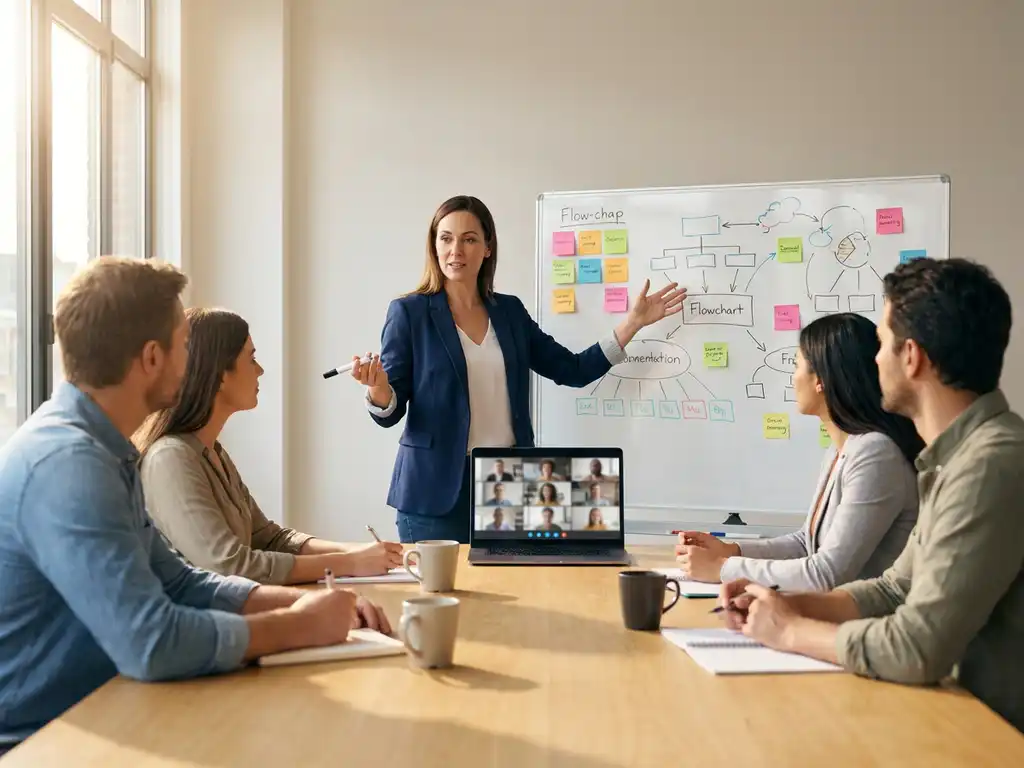
A culture transformation workshop for hybrid teams works best when it combines clear culture goals, practical behavior agreements, and inclusive facilitation that gives remote and in-room participants an equal voice. Run it by diagnosing today’s culture, co-creating new norms, and translating them into measurable actions leaders can reinforce week to week.
This approach supports workplace transformation because hybrid work amplifies communication gaps, siloed decision-making, and uneven employee engagement. A strong internal communication strategy and a change management training mindset help the workshop move from inspiring to operational.
The questions below break down preparation, agenda design, engagement techniques, and how to sustain cultural change after the session.
What is a culture transformation workshop for hybrid teams?
A culture transformation workshop for hybrid teams is a structured, facilitated session where a team defines the culture it needs, identifies the behaviors that support it, and agrees on concrete ways to work together across remote and in-person settings. It blends company culture goals with team culture building so culture building becomes daily practice, not a poster.
In a hybrid setup, culture is shaped less by office atmosphere and more by repeatable moments: how meetings run, how decisions get made, how feedback travels, and how conflict gets handled. A good company culture workshop makes those moments explicit and upgrades them through shared agreements.
- Inputs: current pain points, values, strategy, and real examples of friction
- Outputs: 5 to 10 observable behaviors, meeting norms, and communication rules
- Enablement: change communication tools, leader commitments, and follow-up rituals
Think of it as organizational culture training applied to your real calendar: meetings, handoffs, updates, and decisions.
How do you prepare for a culture transformation workshop in a hybrid setup?
Prepare for a hybrid culture transformation workshop by clarifying the culture outcome, gathering honest input from both remote and in-office employees, and designing logistics that remove participation bias. The goal is to arrive with a shared problem statement and the right mix of voices so the workshop can focus on decisions, not discovery.
Preparation is where creative change management becomes practical. If you skip it, the session turns into vague culture talk or a debate dominated by whoever is loudest or physically present.
- Define the purpose in one sentence: for example, “Create team norms that improve decision speed and psychological safety across time zones.”
- Choose a tight scope: one team, one department, or one cross-functional workflow. Culture building works best when it is specific.
- Collect input fast: run a short pulse survey and 5 to 8 mini interviews. Ask for examples, not opinions: “When did collaboration break down last month?”
- Map hybrid moments that matter: recurring meetings, project kickoffs, handoffs, performance conversations, and async updates.
- Set participation rules: cameras optional, chat enabled, one mic policy, and a plan for equal airtime.
- Pre-align leaders: leaders should commit to modeling the new behaviors. Leading through change starts with visible consistency.
Finally, send a simple pre-read: the purpose, the agenda, and 3 questions participants should reflect on. That small step improves employee engagement because people arrive ready to contribute.
What agenda and activities work best for a hybrid culture workshop?
The best agenda for a hybrid company culture workshop follows a simple arc: diagnose the current team culture, define the target culture, and commit to behaviors and rituals that make it real. Use short, high-energy activities that work equally well on video and in-room, and end with owners, timelines, and measures.
A reliable 90 to 150 minute structure looks like this.
- Opening and norms: set psychological safety, clarify how decisions will be made, and confirm the goal.
- Current culture snapshot: collect examples of what helps and what hurts today.
- Target culture definition: pick 3 to 5 culture principles tied to business outcomes.
- Behavior design: translate principles into “We will” behaviors that are observable.
- Hybrid operating system: meeting rules, async expectations, and decision rights.
- Commitments and follow-up: owners, first experiments, and check-in dates.
High impact hybrid activities
- Culture moments mapping: participants list recurring moments where culture shows up, then vote on the top three to fix.
- Behavior swap: take a frustrating pattern and rewrite it as a specific replacement behavior, such as “We send decisions in writing within 24 hours.”
- Two truths and a tension: each person shares two things that work in hybrid and one tension to solve, which surfaces real constraints quickly.
Change communication tools to bake in
- Decision log: one shared place where decisions, owners, and rationale live.
- Async update template: what changed, what is needed, by when, and who decides.
- Meeting scorecard: a quick rating for clarity, inclusion, and outcomes to support an internal communication strategy.
These activities support change management training goals because they turn culture into repeatable communication behaviors.
How do you facilitate engagement and psychological safety across in-room and remote participants?
Facilitate engagement and psychological safety in a hybrid workshop by designing for equality of voice, not convenience. Use structured turn-taking, multiple ways to contribute, and clear norms that protect candor. When remote participants can influence outcomes as much as in-room attendees, employee engagement rises and the culture conversation becomes trustworthy.
Hybrid workshops fail when the room becomes the “real” meeting and remote people become observers. Fix that with deliberate facilitation.
- Make it remote first: even in-room participants join the same digital board and chat so everyone uses the same channels.
- Use rounds: ask a question, then go person by person with a time box. This prevents dominance and supports quieter voices.
- Separate idea generation from debate: start with silent writing, then cluster themes, then discuss. This reduces groupthink.
- Name the risk: say out loud that disagreement is expected and useful. That simple move strengthens psychological safety.
- Use humor in business carefully: keep it inclusive and business-friendly, and use it to lower tension, not to dismiss concerns.
For tougher topics, add a private input channel. People share more honestly when they can flag sensitive issues without performing in front of peers.
How do you turn workshop outcomes into lasting culture change for hybrid teams?
Turn workshop outcomes into lasting cultural change by converting agreements into a 30 to 90 day experiment plan with visible leadership behaviors, simple metrics, and recurring reinforcement. Culture building sticks when it shows up in meetings, feedback, and decisions every week, supported by a clear communication strategy and consistent management training habits.
Use this practical rollout sequence.
- Publish the culture playbook: one page with principles, behaviors, and hybrid norms. Keep it readable.
- Assign owners: each behavior gets a champion who prompts the team and gathers feedback.
- Run small experiments: for example, “All decisions documented within 24 hours” for four weeks.
- Measure what you can observe: meeting outcome clarity, response times, decision cycle time, and qualitative pulse checks.
- Coach leaders: leading through change requires leaders to model the new behaviors first, especially in hybrid meetings.
- Reinforce with storytelling in change: share short stories of the new culture in action, what changed, and why it mattered.
If you want the shift to last, treat it like a cultural change program, not a one-off session. The workshop sets direction, but repetition creates the new team culture.
How Boom for Business helps with culture transformation workshops for hybrid teams?
We help teams run culture transformation workshops for hybrid teams by combining sharp facilitation, business-friendly humor, and practical change management training so culture decisions turn into daily behaviors. We design sessions that keep remote and in-room participants equally engaged, and we translate culture goals into a clear internal communication strategy teams can actually follow.
- Custom workshop design: agenda, activities, and outcomes tailored to your hybrid reality and culture goals
- Professional facilitation and hosting: high-energy, inclusive sessions that protect psychological safety and drive decisions
- Communication and culture tools: behavior agreements, meeting norms, and change communication tools that support workplace transformation
- Skill building options: management training and employee communication training through interactive workshops that strengthen collaboration
If you want a hybrid company culture workshop that lands with clarity and momentum, contact us at Boom For Business or explore our workshops to plan your session.
Frequently Asked Questions
How many people should attend a hybrid culture transformation workshop?
Aim for 6–14 active participants for one workshop. If the group is larger, run multiple sessions by team or workflow and bring the outputs together in a short “integration” meeting. Keep decision-makers in the room, but include a mix of roles so the norms reflect real day-to-day work.
What tools do we need to run the workshop smoothly in a hybrid setting?
Use one video platform, one shared digital whiteboard, and one shared document for decisions. Test audio (especially in-room mics), set up a single link hub (calendar invite or doc), and assign a tech host to handle troubleshooting so the facilitator can focus on participation and outcomes.
How do we handle time zones without excluding people?
Rotate workshop times across cycles, or split into two shorter sessions that overlap by 45–60 minutes. Collect input asynchronously beforehand (survey + examples) and allow async voting on behaviors afterward so people who can’t attend live still influence the outcome.
How do we choose culture behaviors that are specific enough to measure?
Write behaviors as observable actions with a trigger and a time frame. For example: “After a meeting, the owner posts decisions, owners, and deadlines in the decision log within 24 hours.” If you can’t tell whether it happened by looking at a calendar, chat thread, or document, it’s still too vague.
What if leaders agree in the workshop but don’t follow through afterward?
Build follow-through into the design: ask leaders to pick 1–2 visible behaviors they will model first, schedule a 2-week and 6-week review, and make progress public (simple dashboard or recurring agenda item). If slippage continues, name it as a gap between stated culture and lived culture and reset commitments with clear consequences and support.
How do we adapt the workshop for teams with low trust or recent conflict?
Start with safer topics (process friction, decision clarity) before values language, and use anonymous input for sensitive issues. Set explicit rules for respectful disagreement, use structured rounds, and consider a neutral external facilitator if power dynamics are strong. End with small, low-risk experiments to rebuild trust through consistent delivery.
What should we do in the first week after the workshop to keep momentum?
Publish the one-page playbook within 48 hours, start one experiment immediately, and add two recurring rituals: a 5-minute “norms check” at the end of key meetings and a weekly async update using the agreed template. Quick wins in week one signal that the workshop wasn’t just talk.
Related Articles
- How do you reinforce what participants learned after a workshop?
- How do you apply creative change management in corporate settings?
- What are team building programs for employee wellbeing?
- How do team building activities enhance quick thinking skills?
- What are team building activities for leadership development?