
Workshop lessons stick after the session when participants translate insights into specific behaviors, practice them in real work within 24 to 72 hours, and get consistent reinforcement through prompts, peer support, and manager follow-up. The goal is learning retention that shows up as observable behavior change, not just good feedback forms.
This works best when the workshop follow-up is planned before the workshop ends, tied to real projects, and measured with simple signals like adoption, quality, and consistency. Teams that build reinforcement habits make the learning feel “normal” instead of “extra.”
The questions below break down what makes learning stick, how to do action planning, and how to measure whether it’s working.
What makes workshop learning stick after the session?
Workshop learning sticks when people leave with one or two clear behaviors to apply, a realistic first opportunity to use them, and a lightweight system that reinforces the new habit over time. Strong learning retention comes from repetition in context, feedback, and social reinforcement, not from more content or longer slides.
In practice, “sticky” learning has three ingredients: clarity about what to do differently, opportunity to try it quickly in real work, and reinforcement so the behavior repeats until it becomes automatic.
- Behavior over insight: Convert takeaways into actions you can see and hear in meetings, emails, and decisions.
- Fast first use: Schedule the first application within 24 to 72 hours to prevent forgetting and competing priorities.
- Feedback loops: Use quick reflection and peer input to correct course early.
- Environmental cues: Add prompts in the tools people already use, like calendars, agendas, and templates.
How do you turn workshop insights into an action plan?
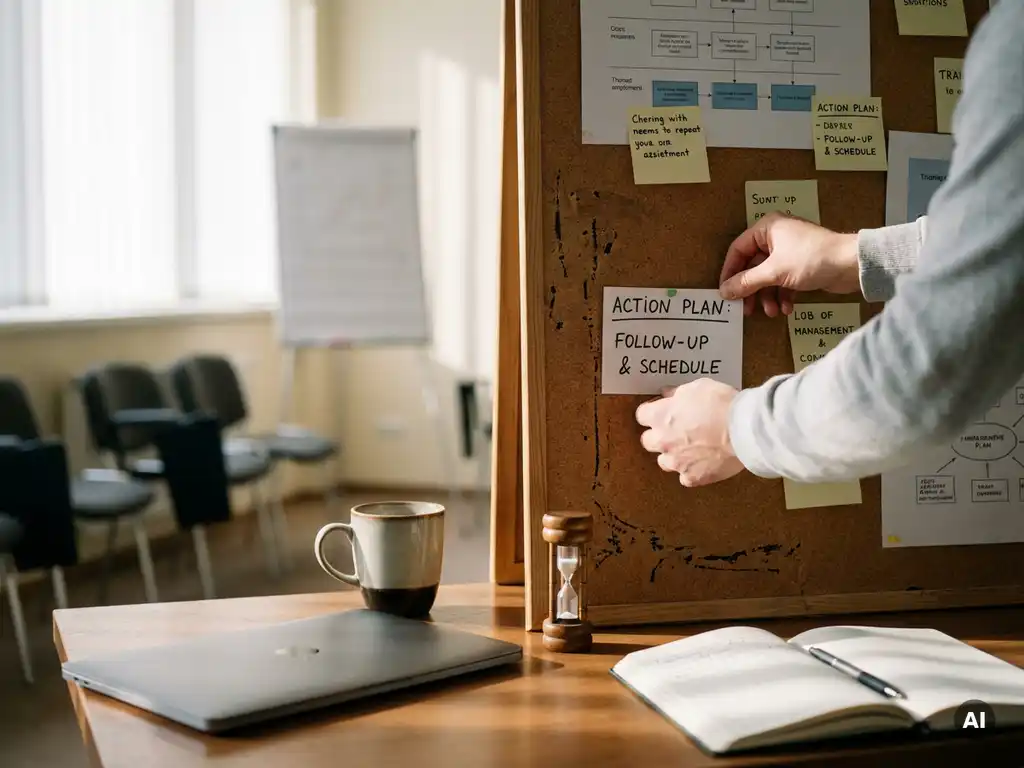
Turn workshop insights into an action plan by choosing a single priority outcome, defining the exact behaviors that support it, and assigning owners, timing, and success criteria. Effective action planning is specific enough to execute next week and simple enough to survive a busy calendar, which is why it drives behavior change.
- Pick one outcome: For example, “clearer decisions in meetings” or “faster handoffs between teams.”
- Name 2 to 3 target behaviors: Example: summarize decisions in one sentence, confirm owners, and set next steps before closing.
- Define the first moment to apply: Identify the next meeting, client call, or sprint planning session where the behavior will be used.
- Assign ownership: One person owns the behavior prompt, another owns capturing examples, and a manager owns follow-up.
- Set a review date: A 10-minute check-in after two weeks keeps the plan alive.
To keep the plan practical, write behaviors in “If X happens, then we do Y” language. That turns good intentions into repeatable triggers, which is the foundation of reinforcement habits.
Which follow-up activities reinforce learning best?
The best workshop follow-up activities are short, frequent, and tied to real work: micro-practice, reminders, peer coaching, and quick reflection. These methods improve learning retention because they create repeated retrieval and application, which strengthens memory and makes the new behavior feel normal in day-to-day routines.
- 24-hour recap: Send a one-page summary with the 2 to 3 behaviors and one example of what “good” looks like.
- Weekly micro-challenges: One small practice task per week, such as opening meetings with a clear goal and closing with decisions.
- Peer buddy system: Pair people to observe one behavior and give quick feedback.
- Manager prompts: Add one question to recurring agendas, such as “What did we decide and who owns it?”
- Two-week retro: A 15-minute reflection on what worked, what felt awkward, and what to adjust.
If you want reinforcement habits to last, keep the activities lightweight. A follow-up that feels like extra admin will lose to inbox pressure every time.
How can managers and teams keep each other accountable?
Managers and teams keep each other accountable by making the new behaviors visible, agreeing on a shared standard, and checking progress in existing rhythms like team meetings and one-on-ones. Accountability works when it feels supportive and specific, because that reduces defensiveness and increases consistent behavior change.
What managers should do weekly
- Ask for examples: “Where did we use the new approach this week?” beats “Are we doing it?”
- Reinforce publicly: Call out the behavior, not the person’s personality, to make it repeatable.
- Remove friction: Update templates, meeting formats, or decision logs so the behavior is easier than the old way.
What teams can do without a manager
- Rotate a “practice lead”: One person per meeting prompts the behavior and captures outcomes.
- Use a shared checklist: A simple list in the agenda keeps reinforcement habits consistent.
- Agree on a reset phrase: A neutral cue like “Can we yes-and this?” or “What’s the decision?” helps course-correct fast.
The key is to treat accountability as a design problem, not a motivation problem. When the environment supports the behavior, people repeat it.
How do you measure whether workshop lessons are sticking?
Measure whether workshop lessons are sticking by tracking observable behaviors, work outputs, and consistency over time, not just satisfaction scores. Strong learning retention shows up when teams apply the skill in real situations, improve the quality of decisions or collaboration, and keep doing it weeks later without heavy prompting.
- Behavior metrics: Count occurrences, such as how often meetings end with clear owners and next steps.
- Quality signals: Review a sample of outputs, like clearer project briefs, better handoffs, or tighter presentations.
- Consistency checks: Compare week 1 to week 4 to see whether reinforcement habits are forming.
- Pulse questions: Ask 2 to 3 targeted questions, such as “I know what is expected of me after meetings” or “I feel heard in discussions.”
Keep measurement simple and tied to the original action plan. If you cannot explain the metric in one sentence, it will not survive a busy quarter.
How does Boom For Business help with workshop learning retention?
We help teams improve learning retention by designing workshops that translate directly into on-the-job behaviors, then supporting workshop follow-up so the lessons keep showing up in real meetings, presentations, and collaboration. Our approach uses practical improvisation and storytelling techniques to build reinforcement habits that feel human, energizing, and easy to repeat.
- Workshops built for application: Sessions that focus on doing, not just discussing, so behavior change starts in the room.
- Clear action planning: Simple next steps that fit existing team rhythms and reduce communication fatigue.
- Reinforcement-friendly formats: Options from one hour to multi-day programs, so practice can match your timeline.
- Culture and communication focus: Tools that strengthen trust, listening, and clarity across teams.
Explore our workshop options, see how we support a positive culture, or browse team-building experiences that keep teams connected. To discuss the right format for your goals, contact us via Boom For Business and we will help you turn one great session into lasting change.
Frequently Asked Questions
How many behaviors should we focus on after a workshop to avoid overwhelm?
Aim for 1–2 “must-do” behaviors per role (or 2–3 per team) for the first two weeks. If you can’t describe the behavior in one sentence and spot it in a real meeting, it’s too broad. Add more only after the first behaviors are consistent.
What if participants don’t have a real opportunity to practice within 72 hours?
Create a low-stakes “practice container” that mimics real work: a 15-minute role-play in the next team meeting, a short async exercise in Slack/Teams, or a rehearsal on an upcoming agenda item. The key is to schedule a specific time and context so practice doesn’t rely on chance.
How do we reinforce learning in remote or hybrid teams without adding more meetings?
Use existing touchpoints: add one prompt to recurring agendas, embed a checklist in shared docs, and run a 3-minute end-of-meeting reflection (“What did we decide? Who owns what?”). Pair buddies for quick async feedback (voice note or comment) instead of live sessions.
What should we do when the new behaviors feel awkward or slow at first?
Normalize the “messy middle.” Keep the behavior small, name what “good enough” looks like, and run a two-week experiment rather than a permanent change. Capture one example per week of the behavior working, and adjust the prompt or template causing friction.
How can we get buy-in from managers or stakeholders who didn’t attend the workshop?
Send a one-page brief with (1) the outcome, (2) the 2–3 target behaviors, (3) what support is needed, and (4) how success will be measured. Ask for one concrete commitment—e.g., a weekly agenda question or approving a template update—so support is visible, not just verbal.
What tools or templates help make reinforcement automatic?
Start with what your team already uses: meeting agendas with a “decision/owner/next step” section, a decision log, a project brief template, and calendar reminders for the first two weeks. Keep templates short and pre-filled with prompts so the new behavior is the default.
When should we run a refresher session, and what should it include?
Plan a 30–45 minute refresher 3–6 weeks later if consistency is dropping or new team members joined. Focus on reviewing real examples, troubleshooting obstacles, and practicing the hardest moment (e.g., disagreeing, closing decisions). Avoid re-teaching the full workshop—optimize for practice and feedback.
Related Articles
- What makes a corporate event host worth the investment for an internal event?
- How do you run team building activities for a team that has never done them before?
- 7 team building activities that strengthen trust between departments
- How do storytelling workshops enhance team communication?
- How do comedy-based team building programs reduce workplace stress?