
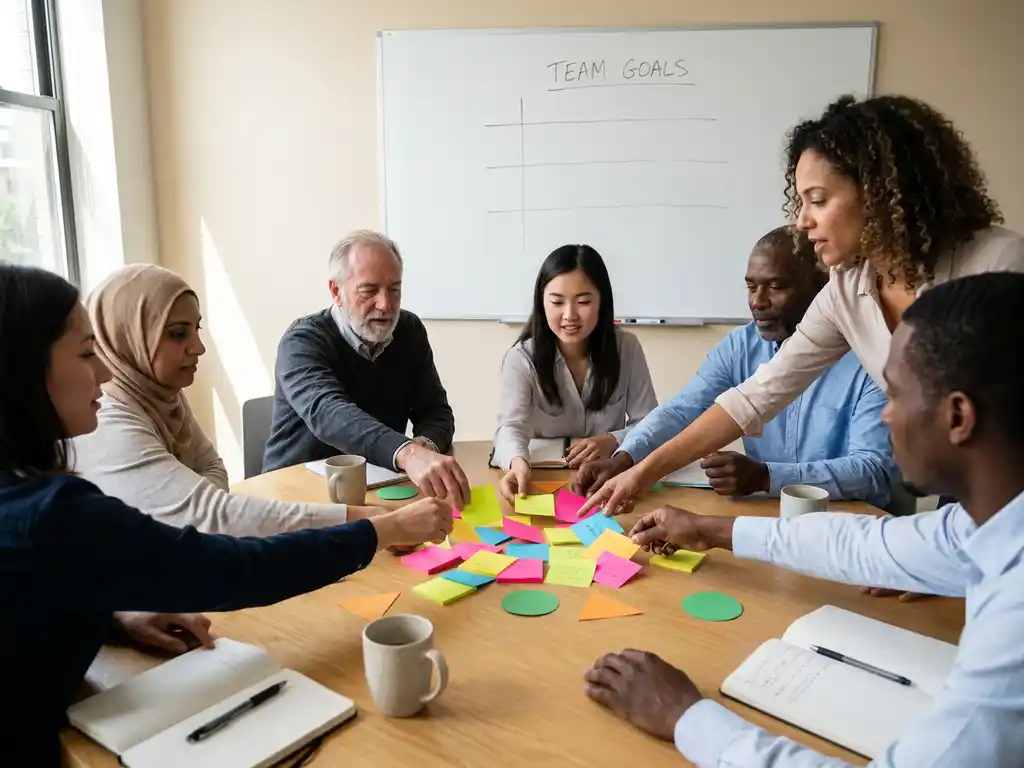
A company culture workshop is a structured, facilitated session where a team clarifies the behaviors, values, and ways of working they want to strengthen, then turns those ideas into practical agreements and next steps. It typically combines honest discussion, interactive exercises, and decision-making so culture becomes observable and actionable, not just aspirational.
These workshops work best when an organization needs alignment during cultural change, workplace transformation, or rapid growth, and when leaders want a clearer internal communication strategy that employees can actually follow. The goal is to make team culture building measurable through specific commitments and follow-up.
The questions below break down how culture transformation workshops run, what activities to expect, and how to make outcomes stick.
What happens in a company culture workshop?
A company culture workshop moves a group from abstract ideas about company culture to concrete behaviors, shared language, and agreed actions. In a 60 to 90 minute or half day format, participants surface what is working, name what is getting in the way, and define the cultural norms they want to practice in daily work.
Most sessions follow a simple arc: diagnose, define, decide. First, the group identifies moments where culture shows up, like meetings, feedback, decision making, or cross team handoffs. Next, they define the desired team culture in plain language, focusing on behaviors people can observe. Finally, they decide what to start, stop, and continue so culture building becomes part of everyday routines.
Because culture and communication are tightly linked, many workshops also address change communication tools: how leaders explain decisions, how managers reinforce messages, and how employees give feedback without fear. When done well, the workshop feels practical, not theoretical, and it supports employee engagement by giving people a voice in how work gets done.
How do facilitators prepare for a culture workshop?
Facilitators prepare for a culture workshop by clarifying the business goal, diagnosing the current culture, and designing activities that fit the group’s reality. They align with sponsors on what must change, what cannot change, and what success looks like, then build a plan that supports psychological safety and honest participation.
Preparation usually includes a short discovery phase so the workshop does not rely on guesses. That discovery can be lightweight, but it should be intentional.
- Define the purpose: culture reset, post merger alignment, leading through change, or improving employee communication training.
- Map stakeholders: who needs to be in the room to make decisions stick, including leaders and influential informal voices.
- Collect inputs: quick interviews, pulse questions, or examples of friction points like meeting overload or siloed handoffs.
- Choose a working model: a small set of culture dimensions such as feedback, ownership, collaboration, and decision making.
- Design guardrails: confidentiality, respectful challenge, and how disagreements will be handled in real time.
Strong preparation also anticipates resistance. If people feel communication fatigue or distrust change programs, facilitators plan for clarity and pacing, and they build in moments where participants can test ideas against real scenarios.
What activities are used in a company culture workshop?
Company culture workshop activities translate values into behaviors through discussion, reflection, and practice. Common exercises include defining culture behaviors, mapping moments that matter, role playing difficult conversations, and creating team agreements. The best activities are interactive and specific, so participants leave with language and habits they can use immediately.
Activities typically mix individual thinking with group alignment to avoid groupthink and to include quieter voices. Examples that work well across industries include:
- Culture moments mapping: identify where culture is most visible, such as meetings, onboarding, feedback, and decision making.
- Behavior sorting: turn vague values into observable actions, for example what “ownership” looks like on a Monday morning.
- Start stop continue: decide which habits support team culture and which ones undermine it.
- Storytelling in change: share short stories of when the culture was at its best, then extract repeatable patterns.
- Role plays: practice feedback, conflict, or change conversations using realistic scripts and constraints.
- Communication strategy drills: rewrite a confusing update into a clear message with a call to action and a feedback loop.
When the organization is in a cultural change program, facilitators often include creative change management elements like improvisation-based exercises. These help teams practice listening, adapting, and responding under uncertainty, which is essential for workplace transformation.
What are the outcomes and deliverables of a culture workshop?
The outcomes of a culture workshop are clear culture behaviors, shared language, and a short list of prioritized actions that leaders and teams commit to. Typical deliverables include a team culture charter, meeting and communication norms, and a change communication plan for how the new behaviors will be reinforced. The goal is clarity people can apply immediately.
Deliverables vary by scope, but strong workshops usually produce tangible artifacts such as:
- Behavior-based culture statements: 5 to 10 “we do” and “we do not” behaviors tied to real work situations.
- Team agreements: norms for meetings, feedback, decision making, and cross team collaboration.
- Communication commitments: expectations for leaders and managers, supporting an internal communication strategy that reduces confusion.
- Priority experiments: 2 to 4 small changes to test in the next 30 days, like a new meeting format or feedback cadence.
- Ownership and timelines: named owners, checkpoints, and what evidence will show progress.
If the workshop includes management training or change management training elements, an additional outcome is skill lift: managers leave with repeatable scripts and routines for leading through change, not just a document.
How do you follow up after a culture workshop to make change stick?
Follow up after a culture workshop by turning agreements into routines, measuring adoption, and reinforcing behaviors through leadership communication. The most effective approach is a 30, 60, 90 day plan with owners, simple metrics, and regular moments to practice. Without follow-up, culture building stays inspirational instead of operational.
To make culture change durable, focus on systems, not slogans. Practical steps include:
- Translate into rituals: add culture behaviors to meeting agendas, retrospectives, and onboarding checklists.
- Equip managers: provide employee communication training tools like message templates, feedback prompts, and escalation paths.
- Run small experiments: test one change at a time, then keep what works and drop what does not.
- Create feedback loops: short pulse questions and open forums to track employee engagement and friction points.
- Recognize behavior publicly: highlight specific actions that match the desired team culture, not vague praise.
Follow-up also needs consistency in change communication. When leaders repeat the same simple story about why the change matters, what is expected, and what support exists, people stop guessing and start acting. This is where storytelling in change becomes a practical tool, not a presentation technique.
How Boom for Business helps with company culture workshops
We help teams run company culture workshops that feel human, energizing, and practical, using business-friendly humor, improvisation, and storytelling to turn culture building into clear behaviors and follow-through. Our approach supports employee engagement while strengthening communication strategy during cultural change, so leaders and teams leave aligned and ready to act.
- Facilitated culture transformation workshops: structured sessions that convert values into observable behaviors and team agreements.
- Organizational culture training: interactive learning that builds real skills for collaboration, feedback, and leading through change.
- Creative change management: improv-based exercises that help teams practice adaptability and communication under pressure.
- Manager enablement: practical change communication tools managers can use immediately in meetings and updates.
If you want a culture workshop that creates momentum instead of another document, explore our workshops or contact us via Boom For Business to discuss your goals and the format that fits your team.
Frequently Asked Questions
Who should attend a company culture workshop (and who should not)?
Invite the people who can both represent day-to-day reality and commit resources: a sponsor/leader, key managers, and influential team members across functions and levels. Keep the group small enough to decide (often 8–20). Avoid “everyone” sessions if you can’t make decisions in the room—run multiple workshops instead and synthesize outcomes.
How do you run a culture workshop for remote or hybrid teams without losing energy?
Use shorter blocks (60–90 minutes), strong facilitation, and more written input to include quieter voices. Combine async pre-work (a short survey + examples of friction points) with live sessions that focus on decisions. Use breakout rooms for behavior drafting, then reconverge to agree on 3–5 norms and owners. Record decisions in a shared doc and confirm them in writing within 24 hours.
What if leaders and employees disagree on what the “real” culture is?
Treat the gap as data, not conflict. Start by collecting concrete examples (“In which meetings does this show up?”) and separate intent from impact. Agree on 2–3 observable behaviors to test for 30 days, then review evidence (pulse results, meeting outcomes, cycle time, rework). Alignment often comes from running small experiments rather than debating values.
How can we measure whether the workshop actually changed behavior?
Pick a few leading indicators tied to the behaviors you chose. Examples: meeting start/end on time, number of decisions documented, feedback frequency, handoff defects, or response-time norms. Pair these with a 3–5 question monthly pulse (“I know what ‘ownership’ looks like here,” “I can raise concerns safely”). Review at 30/60/90 days and adjust rituals accordingly.
What are common pitfalls that make culture workshops fail—and how do we avoid them?
Common pitfalls include vague outputs (“be more collaborative”), no owners, trying to fix everything at once, and inconsistent leadership behavior afterward. Avoid them by limiting outcomes to a small set of behaviors, assigning named owners and dates, building the behaviors into existing routines (agendas, 1:1s, onboarding), and having leaders model the norms publicly within the first week.
How do we handle sensitive topics (trust, conflict, psychological safety) during the workshop?
Set clear guardrails up front: confidentiality, respectful challenge, and how to pause if things escalate. Use structured prompts (write-first, then share) and focus on specific situations rather than personal judgments. If trust is low, consider anonymous input, smaller group sessions, or an external facilitator to reduce power dynamics and keep the conversation productive.
What should we do if we already have company values—do we still need a workshop?
Yes, if values aren’t translating into daily decisions. Use the workshop to operationalize values into “we do/we don’t” behaviors, define where they show up (meetings, feedback, decision-making), and choose 2–4 experiments to embed them. The goal isn’t new values—it’s consistent, observable practice.
Related Articles
- Should we choose coaching or a workshop for our team?
- How do you keep engagement high in virtual company events?
- How do you brief a corporate event host when your program keeps changing?
- What is the difference between team building and team bonding?
- What are team building activities for building emotional intelligence?