
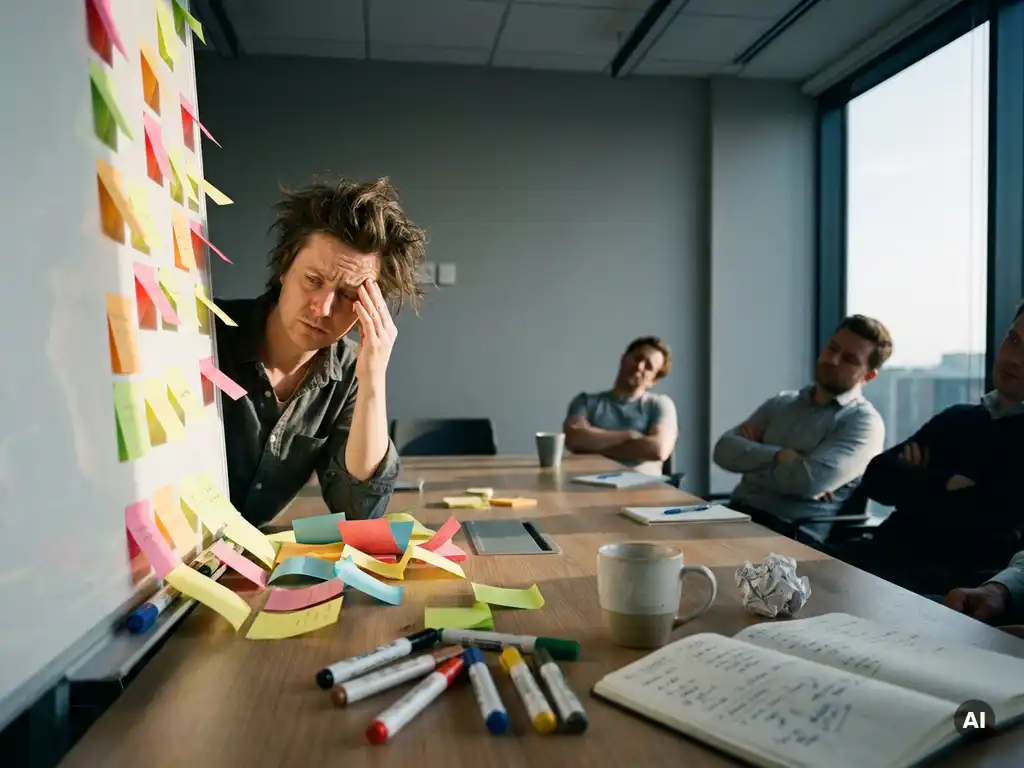
Ineffective brainstorming sessions usually fail because they prioritize speed and volume over clarity, psychological safety, and a workable process. Without a clear problem statement, the right mix of people, and strong facilitation, groups default to familiar ideas, loud voices, and premature judgment, which lowers both quantity and quality.
This breakdown often looks like “brainstorming mistakes” such as vague goals, groupthink in brainstorming, and unstructured discussion that never turns into decisions. The good news is that a few practical changes can dramatically improve outcomes.
The questions below explain why brainstorming goes wrong and how to fix it in a repeatable way.
What makes brainstorming sessions ineffective?
Brainstorming sessions become ineffective when the group lacks a clear challenge, shared rules, and a structured path from ideas to decisions. In practice, ineffective brainstorming happens when people self-censor, the discussion drifts, and the team evaluates too early, so the session produces predictable ideas and no next steps.
Most teams do not fail because they “lack creativity.” They fail because the environment and process make creativity risky or inefficient. If participants do not know what “good” looks like, they will either play it safe or argue about direction instead of generating options.
- Unclear prompt: the problem is too broad or contains hidden assumptions
- No constraints: the group cannot judge tradeoffs, so ideas stay abstract
- Early criticism: evaluation starts before exploration is complete
- Uneven participation: a few voices dominate while others disengage
- No conversion step: ideas never become experiments, owners, or timelines
Why do brainstorming sessions produce few or low-quality ideas?
Brainstorming produces few or low-quality ideas when the session mixes ideation and evaluation, uses a vague question, or asks the wrong people to solve the wrong problem. These conditions create fear of being wrong, reduce cognitive diversity, and push the group toward obvious solutions instead of novel, useful ones.
Quality drops fast when the prompt is framed as a slogan rather than a decision. For example, “How do we innovate?” invites fluff, while “How might we reduce onboarding time without adding headcount?” forces concrete thinking.
- Vague goals: participants cannot tell what to optimize for
- Hidden constraints: budget, legal, brand, or tech limits appear late and kill ideas
- Idea anchoring: the first suggestion sets the direction for everyone else
- Low preparation: no shared facts, customer insights, or examples to build on
- Wrong format: open discussion favors confidence over contribution
To raise quality, separate divergent thinking from convergent thinking, and require each idea to include a user, a behavior change, and a measurable outcome. That simple structure often turns “cool concepts” into testable options.
How do group dynamics derail brainstorming?
Group dynamics derail brainstorming when social pressure overrides independent thinking. Groupthink in brainstorming shows up as people agreeing too quickly, deferring to senior voices, or avoiding unusual ideas to protect status. The result is a narrow set of safe suggestions that feel aligned but do not solve the real problem.
Even high-performing teams can fall into these traps because brainstorming is public. Public thinking increases self-editing, especially across hierarchy, cultures, and personality types.
- HiPPO effect: the highest-paid person’s opinion becomes the default
- Evaluation anxiety: people fear looking uninformed or unrealistic
- Social loafing: some participants contribute less because the group feels responsible
- Production blocking: only one person can talk at a time, so others stop generating
- Conflict avoidance: teams choose harmony over exploring real tradeoffs
You can counter these dynamics with silent idea generation, anonymous clustering, and explicit turn-taking. Most importantly, define psychological safety as a working rule: it must be safe to offer half-formed ideas without punishment.
What facilitation mistakes ruin brainstorming sessions?
Brainstorming facilitation fails when the facilitator does not manage time, energy, and decision flow. Common brainstorming mistakes include letting the group debate the prompt, allowing critique during ideation, and ending without prioritization. A strong facilitator protects the process so participants can focus on thinking, not politics.
Facilitation is not about being charismatic. It is about designing the container: what happens when, how contributions are captured, and how the group moves from many ideas to a few actions.
- No agenda with phases: ideate, cluster, select, and plan get mixed together
- Unclear rules: people do not know whether to build, challenge, or refine
- Overlong discussion: the session becomes a meeting, not an idea engine
- Poor capture: ideas vanish because nobody documents them cleanly
- No decision mechanism: voting, criteria, and ownership are missing
A practical fix is to timebox each phase and announce the goal out loud. For example: 8 minutes silent writing, 12 minutes share and cluster, 10 minutes vote against criteria, 10 minutes assign owners and first experiments.
How can you make brainstorming sessions more effective?
You can improve brainstorming sessions by tightening the problem statement, designing for equal participation, and converting ideas into next steps. Effective brainstorming facilitation uses a repeatable structure: prepare inputs, generate ideas independently, build together, then prioritize with clear criteria and assign owners to test the best options.
- Write a sharp prompt: define the user, the outcome, and the constraint
- Share a one-page brief: key facts, what has been tried, and what success means
- Start with silent ideation: everyone writes before anyone speaks
- Use “yes, and” building: expand ideas before evaluating them
- Cluster and name themes: turn raw ideas into patterns the team can act on
- Prioritize with criteria: impact, effort, risk, and alignment to strategy
- End with experiments: owner, first step, deadline, and how you will measure
If you run recurring sessions, track which ideas became experiments and which experiments became outcomes. That feedback loop improves future prompts and reduces the “we brainstormed but nothing happened” frustration.
How Boom For Business helps with ineffective brainstorming sessions
We help teams fix ineffective brainstorming by combining practical structure with the human skills that make ideas possible: listening, trust, and fast collaboration. Our approach uses business-friendly humor and improvisation techniques to reduce self-censoring, prevent groupthink in brainstorming, and strengthen brainstorming facilitation so sessions produce clear options and real next steps.
- Interactive workshops that train active listening, “yes, and” building, and quick idea development under pressure via improv-based workshops
- Culture foundations that make it safer to speak up and challenge ideas through our Positive Culture program
- Team connection that breaks silos and boosts collaboration with team-building experiences
- Event-level facilitation when you need energy, clarity, and momentum for larger sessions through Boom For Business
If you want brainstorming sessions that consistently produce stronger ideas and faster alignment, contact X to discuss your goals and get a tailored proposal.
Frequently Asked Questions
How many people should be in a brainstorming session?
Aim for 4–8 active contributors. Fewer than 4 limits diversity; more than 8 increases production blocking and makes facilitation harder. If you need broader input, run multiple small groups in parallel and merge themes afterward.
How long should a brainstorming session last to stay productive?
Plan for 45–90 minutes for most challenges. Use short phases (e.g., 5–10 minutes) and schedule a break if you go past 60 minutes. If the problem is complex, split it into two sessions: one for framing and inputs, one for ideation and selection.
What should participants do before the session to come prepared?
Send a one-page brief 24–48 hours ahead and ask for lightweight prep: 2–3 customer quotes/data points, one example of a similar solution, and one “wild” idea. This raises idea quality without turning prep into homework.
How do you run brainstorming with remote or hybrid teams without losing energy?
Use silent writing first (in a shared doc/board), then round-robin sharing to prevent talk-time dominance. Keep cameras optional if it increases comfort, but make participation visible through written contributions. Assign a co-facilitator to manage the tool, timeboxes, and parking lot items.
How do you choose the right ideas without defaulting to popularity or seniority?
Define selection criteria before voting (impact, effort, risk, strategic fit) and use a two-step vote: first for “most promising,” then for “most testable this week.” Consider anonymous voting and require a short rationale per vote to reduce HiPPO effects.
What are good next steps after the session so ideas don’t die?
Within 24 hours, publish a recap with the top themes, the selected ideas, and an experiment plan for each: owner, first action, success metric, and deadline. Schedule a 15-minute check-in 1–2 weeks later to review results and decide whether to scale, iterate, or stop.
How do you handle sensitive topics or conflict during brainstorming?
Set a working agreement up front (assume positive intent, critique ideas not people, and use “I” statements). If tension rises, pause and reframe the prompt or constraints, then return to silent ideation to reduce performative debate. For high-stakes topics, use anonymous input and a neutral facilitator.
Related Articles
- How do you make change management training interactive?
- What is the role of event moderation in making panel discussions work?
- 11 signs your company needs a brand storytelling training program right now
- 7 ways to help your team speak with authority at work from day one
- What are the key responsibilities of an event moderator?