
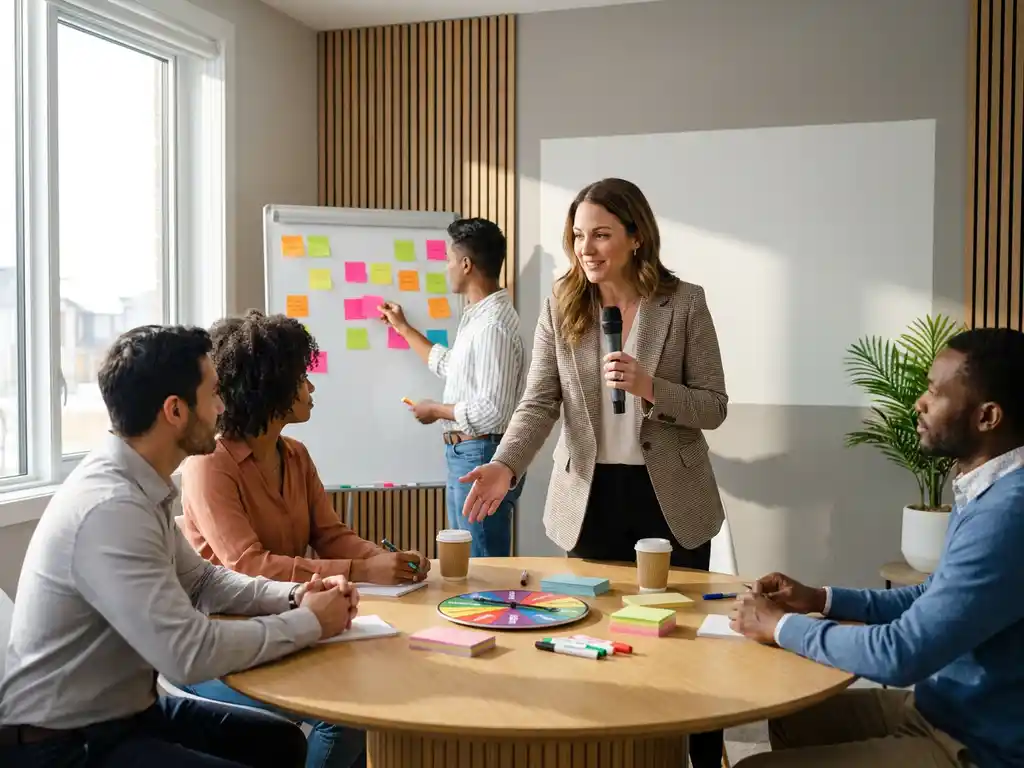
The best interactive formats for internal communication events are those that make employees do something with the message in real time: facilitated small group breakouts, live polling with discussion, scenario-based role play, Q and A that is curated and answered live, and storytelling activities that turn strategy into shared language. These formats consistently improve employee engagement because they replace one-way broadcasting with two-way sense making.
The right choice depends on your internal communication strategy and goals, such as leading through change, strengthening company culture, or aligning managers on change communication tools. In 2026, hybrid attendance is also the norm, so formats must work equally well in-room and on-screen.
Below are the most effective interactive options, how to build an agenda that keeps energy high, and how to measure whether participation actually improved communication.
What makes an internal communication event truly interactive?
An internal communication event is truly interactive when employees can influence the flow, practice the message, and see their input reflected during the session, not after it. Interactivity means participants contribute ideas, questions, and decisions in structured moments, so the event becomes a shared communication strategy exercise rather than a one-way update.
To qualify as interactive, a format should create visible participation and clear outputs. That matters most during workplace transformation and cultural change, where people need space to interpret what the change means for their day-to-day work.
- Two-way exchange: employees ask, vote, challenge, and add context, not just listen
- Shared artifacts: you capture themes, commitments, risks, and next steps live
- Practice over theory: people rehearse conversations, decisions, or behaviors
- Psychological safety: the design makes it easy to speak up without fear
- Facilitated structure: clear prompts and time boxes prevent domination by a few voices
If you want employee communication training to stick, design for participation that produces decisions, language, and actions people can repeat after the event.
Which interactive formats work best for different internal communication goals?
The best interactive formats match the communication goal: use breakouts and scenario practice for change management training, storytelling and values mapping for company culture, and live Q and A with prioritization for leadership alignment. When the format fits the goal, employee engagement rises because people feel the session solves real work problems.
Use these proven pairings to choose quickly.
- Change communication and leading through change: scenario-based role plays, manager toolkits in breakouts, objection handling drills, and decision trees for common questions
- Culture building and team culture building: culture story circles, values-in-action workshops, team agreements, and peer recognition prompts that define desired behaviors
- Strategy and alignment: live polling followed by facilitated discussion, assumption mapping, and priority ranking to surface tradeoffs
- Cross-silo collaboration: rotating roundtables, speed networking with prompts, and shared problem-solving canvases
- Employee voice and trust: curated Q and A, anonymous question collection with theme clustering, and listening sessions with visible follow-up
For creative change management, combine two formats: start with storytelling in change to create meaning, then move into scenario practice so managers can repeat the message consistently.
How do you design an interactive internal event agenda that keeps energy high?
Design an interactive agenda by alternating short inputs with frequent participation cycles every 8 to 12 minutes, then closing with clear commitments and next steps. High energy comes from pace, variety, and facilitation that turns contributions into visible outcomes. This structure works especially well for management training and culture transformation workshop sessions.
A practical agenda pattern that keeps momentum looks like this.
- Open with a shared purpose: one clear outcome and one question you want answered today
- Micro message: a 5-minute leadership update with one story and one decision
- Engagement loop: poll or prompt, then discuss in pairs or small groups, then share themes
- Application block: scenario practice for change conversations or customer impact
- Sense making: capture risks, rumors, and unknowns, then clarify what is decided versus still evolving
- Commitments: each team writes one action and one communication promise
- Close the loop: explain how input will be used and when people will hear back
To keep attention, treat humor in business as a tool, not decoration: use it to lower defensiveness, name the awkward truth, and reset energy before a difficult discussion about cultural change or organizational culture training topics.
What tools and facilitation techniques increase participation in hybrid or remote events?
Participation increases in hybrid or remote internal communication events when you combine simple tech with tight facilitation: one platform for chat and Q and A, fast polls, structured breakouts, and clear turn-taking rules. The goal is to remove friction so employees can contribute in seconds, which improves employee engagement and reduces communication fatigue.
Use tools that support both anonymous and named input, then pair them with facilitation habits that keep the session fair and fast.
- Live polls and word clouds: check understanding and surface sentiment before discussion
- Moderated Q and A: collect questions early, merge duplicates, and answer the top themes live
- Breakout rooms with prompts: give one question, one output, and one spokesperson per group
- Shared digital boards or docs: capture commitments, risks, and ideas in a single place
- Chat protocols: use tags like Question, Concern, Idea to make scanning easier
- Hybrid equity rules: remote voices go first, in-room comments go through a mic, and facilitators read chat aloud
- Time boxing: short rounds prevent rambling and keep energy high
- Warm calling: invite specific roles to respond, with an easy pass option
- Translation of strategy: restate answers as a repeatable line managers can reuse
These techniques also strengthen change communication tools because they create consistent language and reduce the risk of different teams hearing different versions of the message.
How do you measure whether interactive formats improved internal communication?
Measure improvement by tracking whether employees understood the message, felt heard, and changed behavior after the event. The most reliable approach combines quick pulse questions, qualitative theme analysis from Q and A, and follow-up checks on manager conversations. This shows whether your internal communication strategy actually landed, not just whether people attended.
Use a simple measurement stack that matches your goals.
- Understanding: pre and post-event questions like What is changing, why now, and what stays the same
- Confidence: manager self-rating on readiness to lead through change and handle objections
- Engagement signals: participation rate in polls, number of questions, breakout outputs submitted
- Quality of dialogue: themes in questions, recurring concerns, and what people repeat back
- Follow through: completion of team actions, adoption of new rituals, or progress on culture building commitments
For culture change, look for language shift over time. When teams start using the same stories, phrases, and examples, storytelling in change has done its job and your communication strategy is becoming shared culture.
How Boom for Business helps with interactive internal communication events?
We help teams turn internal communication events into high-participation experiences that make change and culture messages stick through professional facilitation, business-friendly humor, and practical improvisation-based methods. When you need creative change management, employee communication training, or a company culture workshop that energizes people without losing seriousness, we design formats that produce clear outputs and repeatable language.
- Interactive event hosting: skilled hosts who keep pace high, handle tough questions, and make hybrid audiences feel equally included
- Custom programs for cultural change: storytelling and improv exercises that support culture building and team culture building with concrete takeaways
- Workshops and masterclasses: organizational culture training and management training that strengthens communication, collaboration, and confidence in leading through change
- Change-ready facilitation: structured Q and A, scenario practice, and change communication tools managers can use the next day
If you want an interactive internal communication event that drives employee engagement and supports workplace transformation, explore Boom For Business and our workshops, then contact us to discuss your goal, audience, and the format that will work best.
Frequently Asked Questions
How long should an interactive internal communication event be for maximum participation?
Aim for 60–90 minutes for a single session, or 2–3 hours with a short break if you need deeper practice. Keep “talking head” segments to 5–7 minutes and run a participation cycle (poll, prompt, breakout, share-back) at least every 8–12 minutes to prevent drop-off—especially in hybrid settings.
How do you handle sensitive or controversial topics without derailing the session?
Set ground rules up front (respect, confidentiality where appropriate, and “challenge ideas, not people”), then use structured channels: anonymous question intake, theme clustering, and time-boxed responses. Name what can’t be answered yet, commit to a follow-up date, and capture unresolved items in a visible parking lot so people feel heard without letting one issue consume the agenda.
What should managers do immediately after the event to reinforce the message?
Within 48 hours, run a 15-minute team huddle using three prompts: (1) “What did you hear?” (2) “What does it change for us this week?” (3) “What questions do we still have?” Share one agreed action and one open question back to the comms owner. This turns event energy into repeatable language and consistent follow-through.
How do you ensure quieter employees and remote attendees contribute equally?
Design for “many small moments” rather than a few big discussions: start with silent writing, use chat-first or anonymous inputs, and assign rotating roles in breakouts (facilitator, scribe, spokesperson). In plenary, invite remote voices first, read chat aloud, and offer an easy “pass” option so participation feels safe rather than forced.
What are common mistakes that make an event feel interactive but fail to create real outcomes?
The biggest pitfalls are collecting input without showing how it will be used, running breakouts without a clear output, and letting Qu0026A become unmoderated. Fix this by defining one tangible artifact per segment (decision, list of risks, commitments), assigning an owner to capture it live, and closing with a clear “you said / we will” summary and timeline.
What’s a simple checklist to prepare speakers and facilitators for a hybrid interactive session?
Do a 20-minute run-through covering: the single outcome, the participation moments and timing, who monitors chat/Qu0026A, how questions are prioritized, how breakout outputs are captured, and the hybrid equity rules (mics, camera placement, remote-first turns). Also prepare 2–3 “bridge lines” speakers can use to translate answers into repeatable manager language.
Related Articles
- What are the most common change management communication mistakes?
- What is creative change management?
- 11 presentation habits every professional needs to develop this year
- 11 ownership mentality training outcomes that matter to senior leadership
- What skills should you look for in a business event facilitator?