
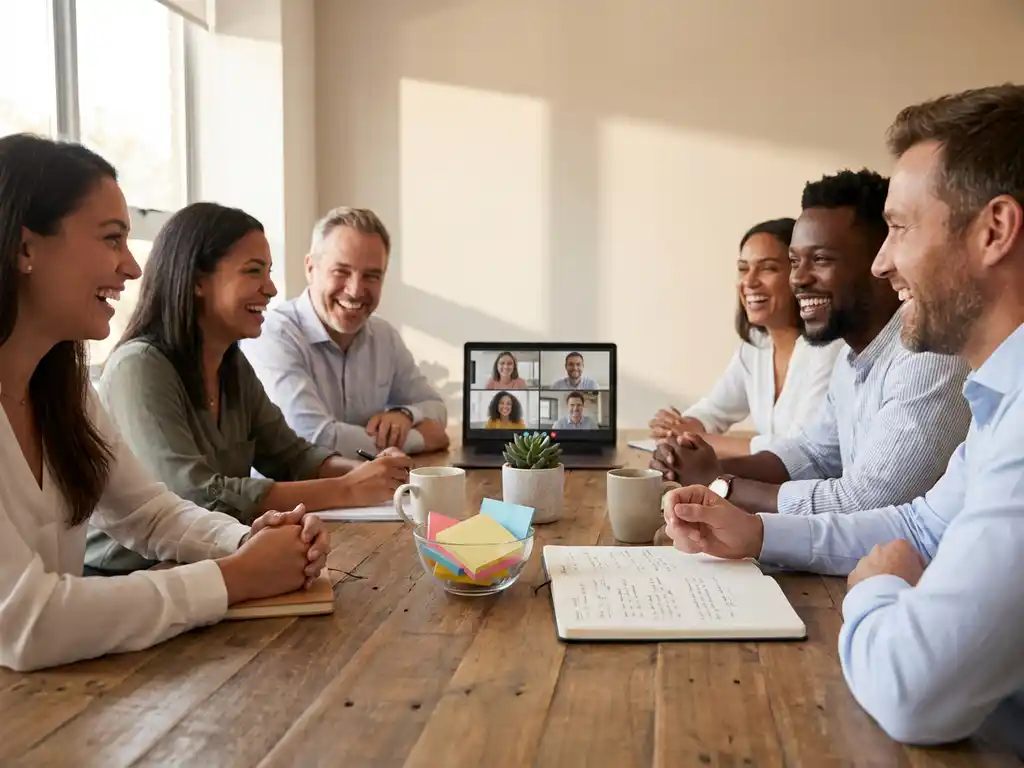
The best culture building practices for hybrid teams are the ones that create shared meaning across locations: clear communication norms, inclusive rituals, and consistent leadership behaviors that reinforce values in everyday work. Hybrid culture thrives when remote and in office employees experience the same standards for belonging, recognition, and decision making.
These practices work best when they support your internal communication strategy and make change communication tools easy to use, not just inspirational. In 2026, teams also need culture building that reduces communication fatigue while increasing employee engagement.
The questions below break down what strong hybrid team culture looks like and how to build it quickly and sustainably.
What does a strong hybrid team culture look like?
A strong hybrid team culture is a shared set of behaviors and expectations that feels consistent whether people work remotely, in the office, or both. It shows up as high trust, clear ownership, and inclusive participation, supported by a communication strategy that makes decisions, priorities, and feedback visible to everyone.
You can usually spot healthy team culture building in hybrid teams through day to day signals:
- Clarity: People know what success looks like, who decides what, and where to find updates.
- Belonging: Remote employees get equal airtime, recognition, and access to informal context.
- Reliability: Meetings start and end on time, actions are tracked, and follow ups happen.
- Psychological safety: People ask questions, admit mistakes, and challenge ideas without fear.
- Energy: The team uses human moments, including appropriate humor in business, to stay connected.
Strong company culture in a hybrid setup is not about forcing everyone to socialize the same way. It is about designing predictable touchpoints where information flows, relationships form, and values become visible in how work gets done.
How do you build culture in a hybrid team without excluding remote employees?
You build culture in a hybrid team without excluding remote employees by designing every cultural moment as remote first, then making the in office experience equally good. That means equal access to information, equal opportunity to contribute, and equal visibility for recognition and growth, all reinforced through a consistent internal communication strategy.
Use these practical culture building moves to keep inclusion real, not symbolic:
- Make participation default: Use one shared agenda, one shared doc, and one shared decision log for everyone.
- Rotate proximity advantages: Rotate who facilitates, who presents, and who gets the first response in discussions.
- Design meetings for equity: One person speaks at a time, cameras optional but engagement required, and chat is treated as a real channel.
- Document informal context: Capture the why behind decisions in short written updates so remote teammates do not miss hallway conversations.
- Recognize outcomes publicly: Praise impact in shared channels, not only in the room where it happened.
If you are driving cultural change or workplace transformation, treat inclusion as a system, not a vibe. The moment remote employees must ask for basics like context, decisions, or visibility, your culture message becomes inconsistent and employee engagement drops.
Which communication norms and rituals strengthen hybrid culture the fastest?
The fastest way to strengthen hybrid culture is to standardize a few communication norms and repeatable rituals that reduce ambiguity. Clear norms cut noise and prevent misunderstandings, while rituals create shared identity. Together they form a practical internal communication strategy that supports leading through change and everyday execution.
Start with a small set of norms that everyone can remember and follow:
- One source of truth: Decide where updates live and stop scattering them across tools.
- Response expectations: Define what is urgent, what is normal, and what can wait.
- Decision hygiene: Record decisions, owners, and deadlines in the same place every time.
- Meeting rules: Agendas in advance, clear roles, and written outcomes within 24 hours.
Then add rituals that build connection without forcing extra meetings:
- Weekly wins and learnings: A short round where each person shares one win and one lesson.
- Monthly retro: What to start, stop, and continue, focused on how the team works.
- Storytelling moments: Leaders and teams share short stories about customer impact or internal progress to reinforce values.
- Onboarding buddy system: A structured first 30 days plan so new hires build relationships fast.
When change is underway, these rituals double as change communication tools. They create predictable spaces to clarify direction, surface concerns early, and keep the narrative consistent across locations.
How can leaders and managers reinforce hybrid culture consistently?
Leaders and managers reinforce hybrid culture by modeling the behaviors they want repeated and by making culture measurable in everyday work. Consistency comes from aligning management training with a clear communication strategy, then reinforcing it through feedback loops, recognition, and decision making that stays transparent across remote and in office settings.
Focus on a few high leverage leadership behaviors:
- Say the why, not just the what: Explain tradeoffs and priorities so people can act independently.
- Run inclusive meetings: Invite input deliberately, summarize often, and close with clear owners.
- Coach in public and in private: Praise impact publicly, give developmental feedback privately and promptly.
- Protect focus: Reduce unnecessary meetings and clarify what can be ignored to fight overload.
- Use consistent language: Repeat key messages so cultural change does not fragment by team or location.
If you are managing a culture transformation workshop or a broader cultural change program, treat managers as your primary channel. Equip them with employee communication training that includes practical scripts, facilitation skills, and storytelling in change so they can translate strategy into daily behaviors without improvising under pressure.
How Boom for Business helps with culture building for hybrid teams?
We help hybrid teams build company culture by turning values and change messages into clear, repeatable behaviors people actually use, supported by high energy facilitation and business friendly humor. Our approach strengthens employee engagement by improving how teams communicate, collaborate, and lead through change across locations.
- Company culture workshop formats: Interactive sessions that define the behaviors you want to see and the norms that make them stick.
- Change management training and management training: Practical tools for managers to communicate clearly, handle resistance, and reinforce culture consistently.
- Organizational culture training with improvisation: Skill building for listening, adaptability, and collaboration under real hybrid constraints.
- Creative change management: Story driven communication that makes strategic transformation memorable and easy to repeat.
If you want a culture transformation workshop or a tailored cultural change program for your hybrid team, start here: Boom For Business or explore our workshops and book an intake to map the fastest path to a stronger hybrid culture.
Frequently Asked Questions
How do we measure whether our hybrid culture is improving?
Pick 3–5 leading indicators and review them monthly: meeting effectiveness (short pulse after key meetings), decision turnaround time (from proposal to recorded decision), participation equity (who speaks/updates in shared channels), onboarding time-to-productivity, and engagement/belonging scores split by remote vs in-office. Set a baseline, define a target, and assign an owner to act on trends—not just report them.
What’s a simple way to prevent “two-tier” culture between office and remote employees?
Make key moments location-agnostic: run all meetings with everyone on their own device, require decisions to be written in a shared log, and move recognition to public channels. If something important happens in the office (a decision, a change in priority, a customer insight), the rule is: “If it isn’t documented, it didn’t happen.”
Which tools should we standardize first to reduce communication fatigue?
Standardize the minimum stack around three jobs: (1) async updates (one channel + a weekly template), (2) decisions (a lightweight decision log), and (3) work tracking (one board or system of record). Then create a “when to use what” guide in one page. Fewer tools with clearer rules beats more tools with vague expectations.
How do we onboard new hires effectively when the team is hybrid?
Use a 30/60/90-day plan with explicit relationship goals: schedule intro 1:1s across locations, assign a buddy, and give a short list of “where things live” (source of truth, decision log, key channels). Add two early wins: a small deliverable in week 1 and a visible contribution in week 3–4 to build confidence and belonging.
How should we handle time zones without excluding anyone?
Default to async for updates and decisions, then reserve live meetings for discussion and relationship-building. Rotate meeting times for recurring sessions, record and summarize outcomes within 24 hours, and use a “24-hour rule” for non-urgent decisions so people in other time zones can weigh in before finalizing.
What should we do when managers aren’t reinforcing the norms consistently?
Make the norms observable and coachable: create a short manager checklist (agenda posted, outcomes documented, decisions logged, recognition shared), review it in manager syncs, and pair managers for peer observation once per quarter. If inconsistency persists, tie adherence to performance expectations and provide targeted training on facilitation and feedback.