
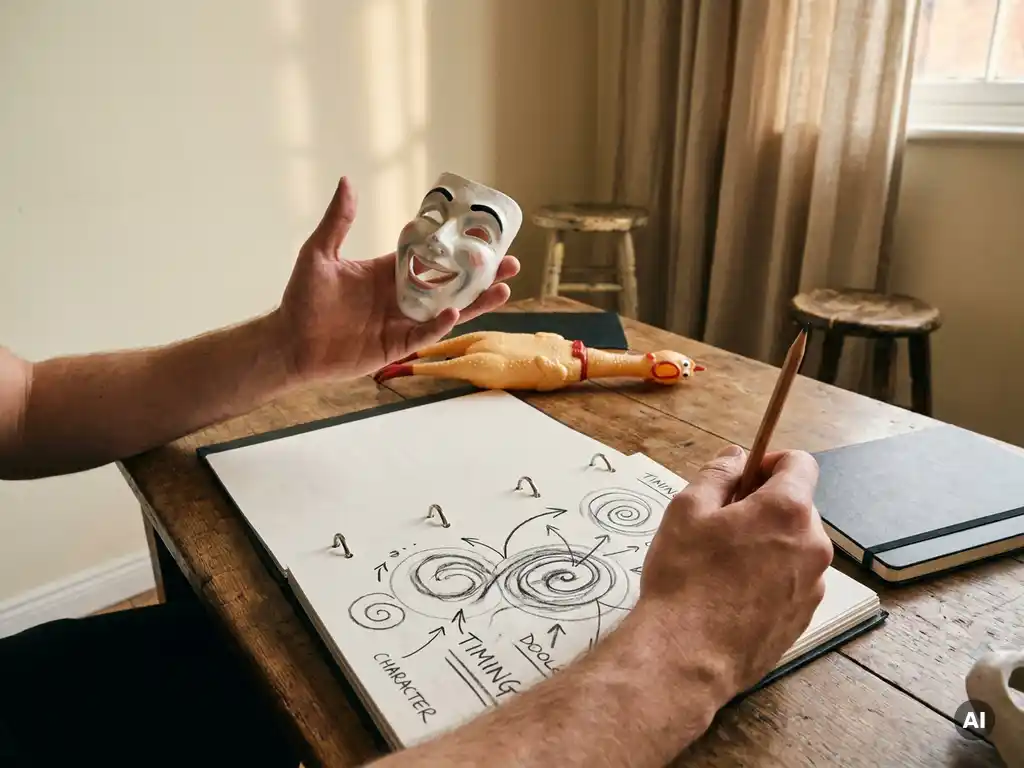
Improv improves creative thinking by training people to generate ideas quickly, build on others’ input, and stay flexible under uncertainty. It strengthens divergent thinking by rewarding many possible options instead of one “correct” answer, while the yes-and mindset keeps ideas moving forward instead of shutting them down.
This works best when teams feel safe to take small risks, make mistakes, and stay curious. In practical terms, improv turns creativity from a talent into a repeatable set of creative thinking skills you can practice in meetings, workshops, and everyday collaboration.
The questions below break down the mechanisms, the conditions that make improv work, and how to apply it without turning brainstorming into chaos.
What is improv and how does it relate to creative thinking?
Improv is a form of unscripted collaboration where participants create scenes, solutions, or stories in real time by listening closely and responding to what others offer. It relates to creative thinking because it trains creativity through rapid idea generation, pattern recognition, and building shared meaning without overplanning.
In business terms, improv is not about being funny on command. It is about practicing behaviors that strong teams need every day: noticing what is happening, accepting new information, and contributing something useful. Those behaviors map directly to creativity at work, especially when problems are ambiguous or changing.
- Attention to signals and constraints, so ideas stay relevant
- Association between unrelated concepts, which fuels novel options
- Co-creation where ideas improve through iteration, not ownership
- Momentum that prevents early judgment from killing promising directions
How does improv train the brain to generate better ideas?
Improv trains the brain to generate better ideas by strengthening divergent thinking, reducing overediting, and improving cognitive flexibility. Because you must respond instantly, you practice producing multiple options, reframing constraints as prompts, and combining ideas from others into new directions, which are core creative thinking skills.
Most teams struggle with creativity not because they lack intelligence, but because they evaluate too early. Improv flips the order: create first, judge later. That sequence matters because evaluation uses different mental resources than exploration. When you separate them, you get more raw material to refine.
- Speed lowers perfectionism and makes “good enough” ideas visible
- Constraints become fuel because you must work with what is offered
- Listening improves originality since you build on real inputs, not assumptions
- Iteration becomes normal so ideas evolve instead of being defended
Over time, teams start to treat uncertainty as workable. That shift alone often unlocks more consistent creativity than any single brainstorming template.
Why does psychological safety matter for creativity in improv?
Psychological safety matters for creativity in improv because people only take the small interpersonal risks that produce original ideas when they expect respect, not punishment. Improv requires offering imperfect thoughts, making mistakes publicly, and adapting fast. Without safety, people self-censor, and improv for creativity collapses into silence or safe clichés.
Creativity is social. Even when one person has the spark, the group decides whether that spark gets oxygen. Psychological safety creates the conditions where “unfinished” ideas can be spoken, heard, and improved.
- More participation from quieter voices, which increases idea variety
- Less fear of looking wrong, which reduces overfiltering
- Faster recovery after missteps, keeping momentum alive
- Better collaboration because people focus on building, not protecting status
A practical signal of safety is how the team responds to the first unusual idea. If the first risk gets shut down, the room will narrow instantly. If it gets built on, the room opens.
How can teams use improv techniques in meetings and brainstorming?
Teams can use improv techniques in meetings and brainstorming by applying the yes-and mindset, structuring idea generation in short rounds, and separating exploration from evaluation. These techniques make it easier to practice improv for creativity in a business setting because they create momentum, equalize airtime, and keep the group in divergent thinking long enough to find stronger options.
Use improv as a lightweight operating system for collaboration, not as a performance. The goal is better thinking, not louder meetings.
Simple improv moves that work in real meetings
- Yes and, then add: acknowledge the idea, then contribute one extension
- Make your partner look good: summarize their point clearly before adding yours
- Name the offer: state the constraint or opportunity you just heard
- One sentence at a time: build a shared concept without monologues
A practical 10-minute brainstorming format
- 2 minutes: silent list of options to widen the pool
- 4 minutes: round-robin sharing, one idea per person per turn
- 3 minutes: yes-and build, each idea gets two improvements from others
- 1 minute: choose evaluation criteria, then schedule evaluation separately
This approach protects divergent thinking early, then brings rigor later. It also reduces the common problem where the most senior voice sets the direction before the group has explored.
What are common mistakes when using improv for innovation?
Common mistakes when using improv for innovation include treating improv as “being funny,” skipping structure, and using yes-and as forced agreement. Improv supports creative thinking skills when teams use it to generate options and build psychological safety. It fails when it becomes chaotic, performative, or disconnected from real constraints.
- Confusing yes-and with yes: you can build on an idea while still testing it later
- Evaluating too early: critique during ideation shrinks the option space
- No clear problem framing: creativity needs a target, even a broad one
- Letting one voice dominate: improv works best with balanced contribution
- Ignoring follow-through: innovation requires a handoff from ideas to decisions
A useful rule is “diverge together, converge deliberately.” Improv helps with the first half. Your meeting design must protect the second half.
How does Boom For Business help with creative thinking?
We help teams improve creative thinking by turning improv into practical, repeatable behaviors that show up in real meetings: deeper listening, faster idea building, and stronger collaboration under pressure. Our sessions are hands-on, business-friendly, and designed to strengthen divergent thinking, psychological safety, and the yes-and mindset without making anyone feel put on the spot.
- Improv workshops that build creativity, communication, and trust through guided exercises from professional improvisers
- Storytelling and presentation practice so ideas land clearly and memorably, not just creatively
- Team-building formats that reconnect colleagues and make collaboration feel natural again
- Programs that fit your schedule, from short sessions to deeper multi-day learning
Explore our workshop options, see how we support a positive culture, or browse team-building experiences. When you are ready to turn improv into everyday creative performance, contact us via Boom For Business to start the conversation and request a quote.
Frequently Asked Questions
How do you introduce improv to a skeptical or introverted team without making it feel awkward?
Start with low-pressure, work-relevant micro-exercises (2–5 minutes) that don’t require acting or humor. Frame it as a collaboration skill drill, not a performance. Use pairs or small groups, allow “pass” as an option, and model short, imperfect contributions so people see the bar is intentionally low.
What’s the difference between “yes-and” and agreeing with everything?
“Yes-and” means you acknowledge what was offered and add information to move the idea forward. You can still disagree later during evaluation. A practical script is: “Yes—and if we keep the goal X, we could try Y,” or “Yes—and what if we test it with Z constraint?”
How can remote or hybrid teams use improv techniques effectively?
Use tight facilitation and visible turn-taking. Try timed rounds (30–60 seconds per person), use chat for silent idea seeding, and build with a shared doc or whiteboard so offers don’t get lost. Keep cameras optional if that increases safety, and end with a clear handoff: who captures ideas, what gets tested, and by when.
How do you measure whether improv is actually improving creative thinking at work?
Track a few simple indicators before and after: number of distinct options generated in a set time, participation balance (who speaks and how often), time-to-first-idea, and follow-through (ideas moved into experiments). Pair that with a short pulse survey on psychological safety and meeting usefulness to see whether behavior is changing.
What should you do when someone shuts down ideas with “yes, but…” or criticism during ideation?
Name the phase and redirect. Use a rule like “no critique for 5 minutes” and give people a replacement move: “Yes—and…” or “Yes—what would make it work?” If the concern is valid, park it in a visible “Later” column for evaluation so it’s respected without stopping momentum.
How do you move from improv-style ideation to real decisions and execution?
Schedule convergence explicitly. After ideation, cluster ideas, pick 2–3 criteria (impact, effort, risk), and choose one or two options to test. Convert the winner into a small experiment with an owner, a deadline, and a success signal. Treat the next meeting as a review of learning, not a re-brainstorm.
Are there situations where improv isn’t the right tool for innovation?
Yes. If the problem is highly regulated, safety-critical, or already well-defined, you may need analysis and checklists more than divergence. Improv is most useful when the challenge is ambiguous, cross-functional, or stuck in early-stage exploration—then you can switch to more rigorous methods for validation and delivery.
Related Articles
- What is storytelling in change?
- How do you run a collaborative team workshop for a group that struggles to agree?
- 7 entrepreneurial mindset workshop activities that shift how teams approach problems
- How do team building activities enhance creative thinking?
- What are competitive team building challenges?