
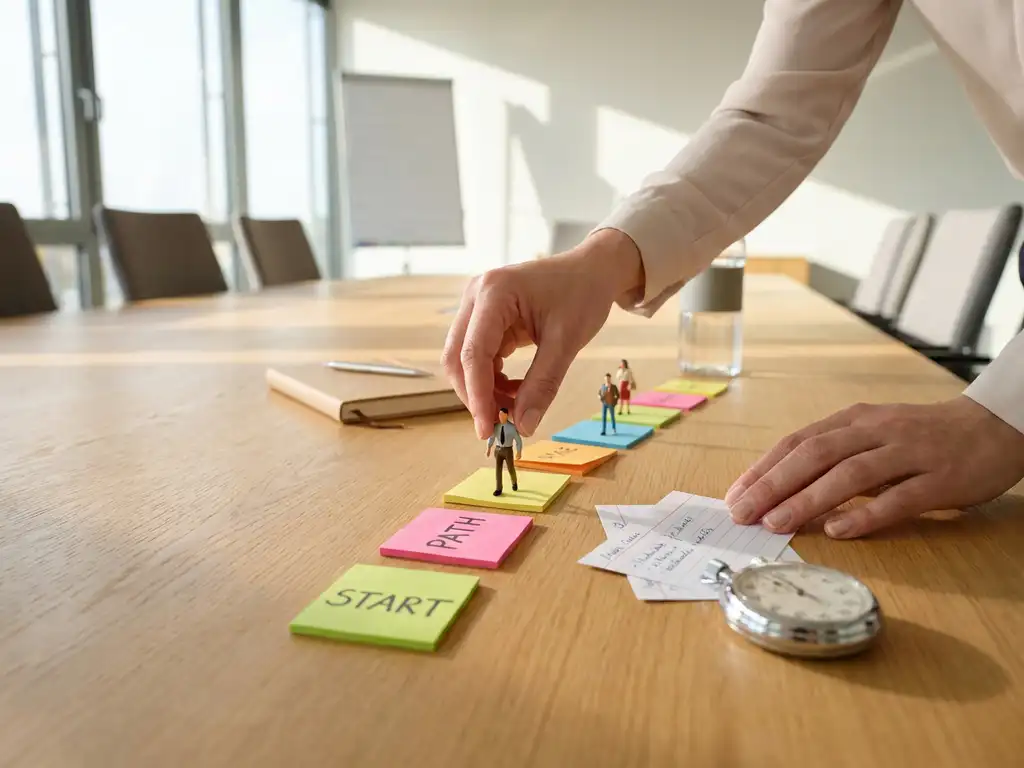
Design events that drive real behavior change by starting with one or two specific behaviors, engineering repeated practice during the event, and reinforcing those behaviors with follow-up cues and accountability afterward. Behavior change happens when people know exactly what to do, feel safe trying it, and see leaders model it consistently.
This approach works best when your event is treated as a change communication tool, not a one-time broadcast. The most effective programs combine clear goals, interactive formats, and a practical internal communication strategy that continues long after the closing slide.
The questions below break down how to define, design, and sustain behavior change through events in 2026.
What does “behavior change” mean in an event context?
In an event context, behavior change means participants leave and consistently do something differently at work, not just think differently or feel inspired. The event creates a clear trigger, a shared language, and a safe space to practice new habits that support cultural change, employee engagement, and workplace transformation.
To make “behavior change” concrete, define it as observable actions that colleagues can notice within days. Examples include asking one better question in meetings, giving feedback using a shared framework, escalating risks earlier, or running handoffs with a new checklist. These are small, repeatable moves that accumulate into team culture building and broader culture building.
It also helps to separate three layers:
- Knowledge: people understand the change and the “why” behind it
- Skill: people can perform the new behavior under real constraints
- Norm: the group expects and rewards the new behavior as part of company culture
Events can accelerate all three, but only if the agenda includes practice and social reinforcement, not just presentations.
How do you set behavior-based event goals that are measurable?
Set measurable behavior-based event goals by writing them as observable actions, defining the moment they should happen, and choosing a simple way to track adoption. Good goals sound like “Managers will run weekly check-ins using a two-question format” rather than “Improve communication.” This turns management training into measurable change.
A practical method is to write goals in a “Who does what, when, and with what standard” format:
- Who: which roles must change first, such as people managers or project leads
- What: the exact behavior, such as “name the decision owner before discussion”
- When: the trigger moment, such as “at the start of every meeting”
- Standard: what “good” looks like, such as “in under 30 seconds, every time”
Then pick lightweight measurement that matches the behavior:
- Self reporting: a two-minute weekly pulse on whether the behavior happened
- Peer observation: rotating “meeting spotters” who note if the habit showed up
- Artifact checks: do meeting notes, project boards, or handoff docs reflect the new norm
This is where change management training and employee communication training connect: you are not measuring satisfaction with the event, you are measuring adoption of the new way of working.
Which event formats are most effective for changing behavior?
The most effective event formats for changing behavior are interactive formats that encourage safe repetition, feedback, and reflection. Workshops, simulations, role play, and facilitated practice sessions outperform lecture-style keynotes because they build skill and confidence in the moment. These formats also support creative change management by making change feel doable.
Choose formats based on the type of behavior you need:
- For communication strategy shifts: scenario-based practice, message mapping, and “say it in one sentence” drills
- For leading through change: manager simulations, difficult conversation role plays, and decision-making exercises
- For team culture: cross-functional problem solving, norms workshops, and structured peer feedback
- For storytelling in change: story circles where leaders and teams practice a consistent narrative
Humor in business can be a powerful accelerant when it is business-friendly and purposeful. It lowers defensiveness, makes sensitive topics discussable, and helps people remember the new language. The key is to use humor to reveal patterns and invite ownership, not to distract from the work.
How do you design the agenda to increase participation and psychological safety?
Design an agenda that increases participation and psychological safety by reducing performance pressure, creating clear participation rules, and building from low-risk to high-risk activities. People engage when they know what is expected, feel respected, and see leaders model curiosity. This is essential for employee engagement and for any culture transformation workshop.
Use these agenda design principles:
- Start with clarity: name the purpose, the behaviors you are practicing, and what “good participation” looks like
- Warm up gradually: begin with pair shares and small groups before plenary discussion
- Make it structured: use timed rounds, prompts, and roles so extroverts do not dominate
- Normalize imperfection: frame practice as experimentation, not evaluation
- Close the loop: end each segment with “What will you do differently on Monday”
Also design for inclusion. Offer multiple ways to contribute, such as speaking, writing, voting, or small group facilitation. When people can participate in a way that fits them, you get better data, better buy-in, and stronger organizational culture training outcomes.
How do you reinforce behavior change after the event?
Reinforce behavior change after the event by turning the new behaviors into prompts, routines, and accountability mechanisms inside daily work. The event creates momentum, but reinforcement creates habit. The most reliable approach combines manager follow-through, simple change communication tools, and repeated reminders embedded in existing workflows.
Build a 30-day reinforcement plan that includes:
- One page behavior playbook: the new norms, examples, and “what to do instead” guidance
- Manager cadence: weekly check-ins that ask about practice, obstacles, and next steps
- Peer reinforcement: buddy systems or team agreements that make the norm social
- Environmental cues: templates, meeting openers, and channel prompts that trigger the behavior
- Visible leadership modeling: leaders use the same language and reward the behavior publicly
Connect reinforcement to your internal communication strategy. Instead of sending more messages, send fewer, more consistent messages that repeat the same behavioral ask, show examples from real work, and clarify what success looks like.
How does Boom for Business help with behavior change through events?
We help teams drive real behavior change by combining professional facilitation, business-friendly humor, and practical practice design so people do not just understand the message, they rehearse it and can use it at work. Our approach supports culture building, employee engagement, and change management training by making change feel human, safe, and memorable.
- Interactive formats that build skill: workshops and simulations that turn communication strategy into repeatable behaviors
- Improvisation and storytelling: tools for leading through change and making change narratives land with impact
- Custom programs for cultural change: tailored sessions that support a cultural change program and team culture building across departments
- High energy hosting: facilitation that keeps participation high while protecting psychological safety
If you want an event that creates measurable follow-through, explore our workshops or contact us directly via Boom For Business to design a program around the behaviors your organization needs next.
Frequently Asked Questions
How many behaviors should we target in a single event to avoid overload?
Aim for 1–2 core behaviors per event (or per audience segment). If you need more, group them under one “umbrella” habit and teach the smallest repeatable moves. A good test: participants should be able to describe the behavior in one sentence and practice it at least 3 times during the event.
What should we do if leaders support the change verbally but don’t model the behavior?
Make modeling a defined deliverable, not a vague expectation. Give leaders a short script, a visible moment to demonstrate the behavior (e.g., the first meeting after the event), and a simple feedback loop (peer observer or team pulse). If leaders can’t commit, narrow the behavior to what teams can control and escalate the risk early.
How do we adapt behavior-change events for hybrid or fully remote teams?
Design for shorter practice cycles and more written participation. Use breakout rooms with clear roles, shared templates (docs/boards) that capture the behavior, and “camera-optional” options to reduce pressure. Afterward, embed cues in the tools people already use (calendar invites, meeting agendas, Slack/Teams prompts) so the behavior shows up in real work.
What’s a realistic way to measure behavior change without creating survey fatigue?
Use one primary signal and one backup signal for 30 days. For example: a 2-question weekly pulse (primary) plus an artifact check (backup) like meeting notes or project boards. Keep it under 2 minutes, report results back to teams, and tie measurement to learning (“what’s blocking us?”) rather than compliance.
How do we handle resistance or cynicism during practice activities?
Treat resistance as data. Name the concern, ask for a real scenario, and run a quick “try it both ways” comparison so people can feel the difference. Offer opt-in roles (observer, timekeeper, note-taker) to keep participation safe, and capture objections as design inputs for the follow-up playbook and manager check-ins.
What should the first week after the event look like to lock in momentum?
Schedule a “Day 2” within 5–7 days: a 30-minute team check-in to review the behavior, share one win, and remove one obstacle. Add one environmental cue (template or meeting opener), assign a buddy/spotter for the week, and have a leader publicly recognize an example of the behavior in action.
When should we bring in an external facilitator versus running it internally?
Bring in an external facilitator when the topic is sensitive, cross-functional trust is low, or you need neutral enforcement of participation rules. Run it internally when you have strong facilitation skills in-house and leaders can model the behavior consistently. A hybrid approach often works best: external design/facilitation for the first cycle, then internal leaders trained to sustain it.
Related Articles
- Which workshop helps teams communicate more effectively regardless of seniority?
- Which KPIs show whether training was effective?
- Can event moderation improve the way employees experience internal events?
- 7 collaborative team workshop formats that break down departmental silos
- What techniques do event hosts use to maintain energy?