
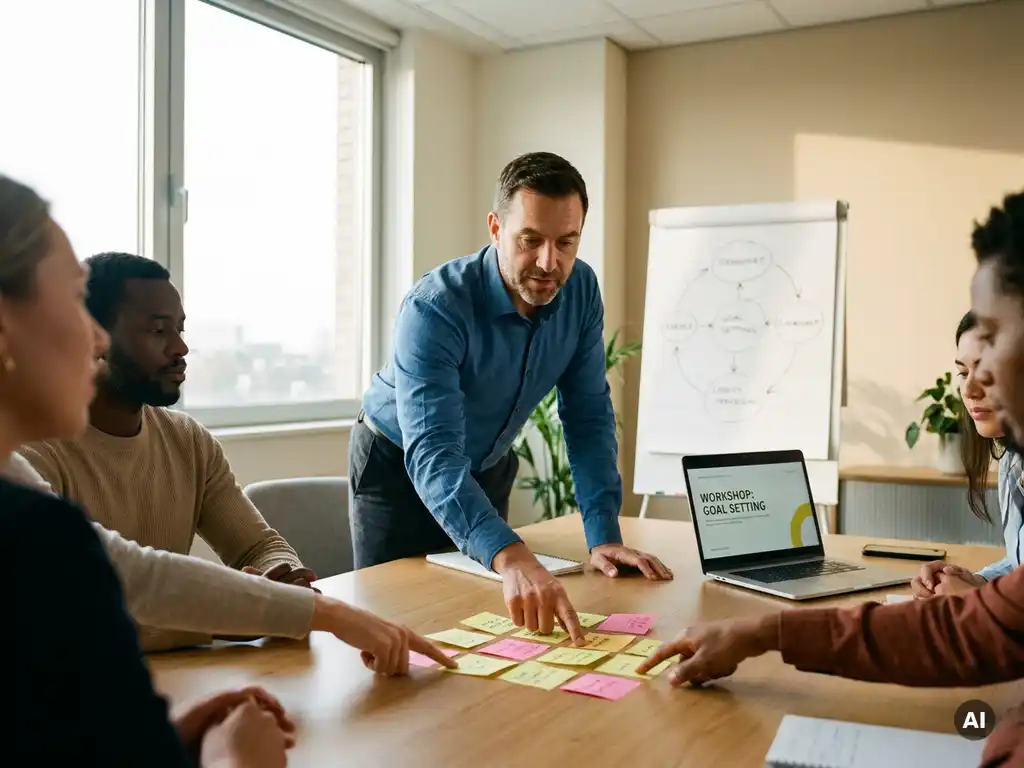
Yes, coaching and workshops can be combined for teams, and the combination often works better than either approach alone because it blends real-time skill practice with ongoing, personalized support. A well-designed mix turns a one-off learning moment into sustained behavior change that shows up in daily work.
This approach is especially useful when teams face communication fatigue, low engagement, or complex change messages that need to land clearly across departments. The key is to design the coaching and the workshop elements as one connected journey with shared goals and measurable outcomes.
The questions below break down what a combined team coaching and workshops approach looks like, why it works, how to build it, and how to measure results.
What does it mean to combine coaching and workshops for teams?
Combining coaching and workshops for teams means running interactive group sessions to build shared skills, then reinforcing those skills through targeted coaching that helps people apply them in real situations. In a strong team development program, workshops create alignment and practice, while coaching turns that practice into consistent habits and better performance.
Think of workshops as the place where the team learns and rehearses together, and coaching as the place where individuals or leaders remove blockers, refine communication, and stay accountable to the new behaviors.
- Workshops build a shared language, tools, and expectations across the group.
- Coaching personalizes the tools, supports transfer to the job, and accelerates adoption.
- The combination reduces the common drop-off after training by creating follow-through.
This blended learning for teams is particularly effective when you want both culture change and practical communication improvements, not just a fun day or a slide deck.
Why combine coaching and workshops instead of choosing one?
Teams combine coaching and workshops because workshops alone can feel inspiring but fade quickly, while coaching alone can stay too individual and miss team-wide alignment. Team coaching and workshops together solve both problems by creating shared practice and then supporting real-world application, which improves consistency across roles and departments.
In medium to large organizations, internal communication often breaks down because people interpret messages differently, managers translate updates inconsistently, and teams operate in silos. A combined approach tackles those issues from two angles at once.
- Faster alignment: workshops get everyone on the same page at the same time.
- Better adoption: coaching helps people use the tools in their actual meetings, presentations, and feedback moments.
- Higher engagement: interactive team-building workshops create energy and buy-in, which makes coaching feel relevant instead of remedial.
- More resilient change communication: teams practice how to talk about change clearly, then leaders get coached to deliver the message with confidence.
If your goal is lasting behavior change, not just a memorable session, the blended route usually wins.
How do you design a combined coaching-and-workshop program that works?
Design a combined coaching and workshop program by starting with one clear performance goal, then mapping workshops to teach and practice the behaviors, and coaching to reinforce them in real work. The best blended learning for teams uses short cycles: learn together, apply immediately, get coached, and repeat until the behavior becomes normal.
A practical structure looks like this:
- Define outcomes in plain language such as clearer updates, better cross-team collaboration, or stronger psychological safety in meetings.
- Diagnose the current reality using quick stakeholder interviews, a short survey, or observation of key meetings to spot the real friction points.
- Run a skills workshop focused on a small set of behaviors the team can practice immediately, like active listening, concise storytelling, or giving usable feedback.
- Add coaching sprints for leaders, project owners, or key communicators to apply the tools to upcoming moments like town halls, strategy rollouts, or stakeholder presentations.
- Build in application assignments such as rewriting one update, redesigning one meeting, or testing one feedback habit for two weeks.
- Reinforce with a follow-up workshop to share wins, troubleshoot obstacles, and raise the difficulty level.
To keep the program from becoming “extra work,” tie every exercise to existing workflows: the meetings people already attend, the messages they already send, and the decisions they already need to align on.
What’s the difference between coaching, training, facilitation, and team building?
Coaching, training, facilitation, and team building differ by purpose and method: coaching improves performance through personalized guidance, training teaches defined skills, facilitation helps a group reach decisions and alignment, and team building strengthens connection and trust through shared experiences. Understanding coaching vs. workshops helps you choose the right mix for your team’s goal.
- Coaching: individualized or small-group support focused on real challenges, habits, and communication impact.
- Training: structured learning with a curriculum, practice, and feedback on specific skills.
- Facilitation: guiding a group process so the team can think clearly, discuss safely, and decide effectively.
- Team building: experiences that build relationships, trust, and collaboration, often by doing something active together.
In practice, strong team development programs blend these elements. For example, a workshop can teach storytelling, facilitation can help the team align on strategy, coaching can refine leaders’ messages, and team-building workshops can create the trust that makes honest conversations possible.
How do you measure whether coaching and workshops are improving team performance?
You measure whether coaching and workshops improve team performance by tracking behavior change and business-relevant outcomes, not just satisfaction scores. A solid approach combines before-and-after self-assessments, observable meeting behaviors, and operational signals like faster decisions or fewer misunderstandings. Measurement works best when you define success upfront and review it regularly.
Use a simple measurement stack that matches your goals:
- Behavior metrics: Are meetings more focused, are roles clearer, do people ask more clarifying questions, do updates get shorter and more actionable?
- Communication quality checks: Do employees understand the “why” behind changes, can they repeat priorities accurately, do managers feel equipped to communicate?
- Collaboration signals: Are handoffs smoother, are cross-team conflicts resolved faster, do projects stall less often due to misalignment?
- Psychological safety indicators: Do more people speak up, admit mistakes earlier, and offer ideas without fear of shutdown?
Keep it lightweight. A few consistent checkpoints beat a complex dashboard nobody maintains. In 2026, teams also benefit from measuring communication load: fewer repeat questions and fewer clarification threads often signal that messages land the first time.
How does X help with combining coaching and workshops for teams?
We help teams combine coaching and workshops by designing one connected journey that builds shared skills, strengthens culture, and makes key messages land with clarity and energy. Our approach uses professional improvisation and storytelling to help teams listen deeply, adapt quickly, and make each other look good, then reinforces those behaviors through practical coaching.
- Interactive workshops that sharpen communication, collaboration, and presentation skills through hands-on improv-based exercises
- Coaching for leaders and key communicators to clarify the true message, improve delivery, and stay flexible during change
- Flexible formats from one hour to one day to one week, designed around your real meetings, strategy moments, and internal communication needs
- Culture-focused programs that build trust, ownership, and psychological safety through everyday behaviors
- High-energy team-building workshops that create real connection and make learning stick through shared laughter
Explore our approach at Boom For Business, review our workshops, see our Positive Culture program, or browse our team-building options, then reach out to request a tailored proposal for your team.
Frequently Asked Questions
How long should a combined coaching-and-workshop program run to create real behavior change?
Most teams see meaningful change in 6–12 weeks when the program includes at least two workshops plus short coaching sprints in between. A practical starting point is: Workshop 1 (skills + shared agreements), 2–4 weeks of coaching and on-the-job practice, then Workshop 2 (reinforcement + troubleshooting). If you’re under time pressure, run one workshop and add 3–5 coaching sessions focused on the next “high-stakes” communication moments.
Who should receive coaching in addition to the workshops?
Prioritize the people who shape communication flow: people managers, project/program leads, and anyone delivering change messages (e.g., product, HR, comms). If budget is limited, coach a small “multiplier group” (5–10% of the team) and give them clear responsibilities—model the behaviors in meetings, reinforce shared language, and capture examples the team can learn from.
What should we do before the first workshop to make the time worthwhile?
Do a lightweight pre-work step that surfaces real work examples. Ask participants to submit: one meeting that feels inefficient, one message that created confusion, and one upcoming moment that matters (a rollout, town hall, stakeholder update). Share a one-page brief with the program goal, what “good” looks like, and how you’ll measure progress so the workshop starts with relevance, not theory.
How do you keep coaching from feeling like remediation or performance management?
Position coaching as implementation support, not correction. Make it opt-in where possible, tie it to shared team goals, and focus sessions on real deliverables (an agenda, a narrative, a feedback conversation) rather than personality. Also set clear boundaries: coaching is confidential, separate from HR processes, and aimed at helping people succeed in the new ways of working.
How can remote or hybrid teams run this blend without adding meeting overload?
Use shorter, more frequent touchpoints: 60–90 minute virtual workshops, then 20–30 minute coaching sessions that plug into existing rhythms (1:1s, project check-ins, leadership meetings). Replace—not add—one standing meeting with a practice session, and use shared templates (agenda, decision log, update format) so the new behaviors show up asynchronously too.
What are common failure points, and how do we avoid them?
Common pitfalls include trying to cover too many skills at once, not tying practice to real work, and skipping reinforcement. Avoid them by choosing 1–2 behaviors per cycle, assigning a real-world application task after each workshop, and scheduling coaching within 7–10 days so momentum doesn’t fade. Finally, name an internal owner to track follow-through and keep the program connected to business priorities.
What should we ask a provider before hiring them for workshops plus coaching?
Ask for specifics: (1) How will you diagnose our real communication friction points? (2) What behaviors will you target, and how will you measure them? (3) What does a sample agenda and coaching plan look like? (4) How do you handle confidentiality and psychological safety? (5) How will you adapt for our context (remote/hybrid, cross-functional, time zones)? Choose a provider who can show a clear journey, not just a great workshop.
Related Articles
- What is the ROI of business team training?
- How do you build psychological safety through internal communication?
- How do you build a communication strategy for organizational change?
- How do you choose change communication tools for a global workforce?
- What makes an employee engagement workshop worth the investment for a B2B company?