
The best exercises to improve creative thinking at work are short, repeatable activities that force divergent thinking first and convergent thinking second. Use quick idea sprints, constraint prompts, and improv-style listening games to generate more options, then apply simple filters to choose what to test.
These creative thinking exercises work especially well in busy workplaces because they reduce overthinking, cut through communication fatigue, and make it safer to share imperfect ideas. The key is consistency: a few minutes daily beats a long session once a quarter.
Below are practical, question-by-question answers you can use immediately with individuals or teams.
What are the best quick exercises to boost creative thinking at work?
The best quick exercises to boost creative thinking at work are time-boxed prompts that generate many options fast, without judging them. In 5 to 10 minutes, you can unlock workplace creativity by switching perspectives, adding constraints, and capturing ideas visually. The goal is quantity first, then a quick sort for quality.
- 5-minute “10 ideas” sprint: Write 10 solutions to one problem, no repeats. If you get stuck, write “worse” ideas until a good one appears.
- SCAMPER mini round: Substitute, Combine, Adapt, Modify, Put to another use, Eliminate, Reverse. Pick 2 letters only to stay fast.
- Constraint flip: Add one constraint like “no budget,” “no meetings,” or “must ship in 48 hours,” then ideate within it.
- Role swap: Ask, “How would a customer, a new hire, or a competitor solve this?”
- Crazy 8s: Fold paper into 8 boxes, sketch 8 rough concepts in 8 minutes. Great for product, comms, and event ideas.
To make these stick, end with a 60-second close: circle the top two ideas, name the smallest test, and assign an owner.
How do brainstorming alternatives improve idea quality compared to classic brainstorming?
Brainstorming alternatives improve idea quality because they reduce groupthink, prevent loud voices from dominating, and separate idea generation from evaluation. Classic brainstorming often mixes talking, judging, and status dynamics, which narrows options. Structured divergent thinking techniques create more variety, then use clear criteria to select stronger ideas.
Which alternatives work best for workplace creativity?
- Brainwriting 6-3-5: 6 people write 3 ideas in 5 minutes, then pass and build. Quiet, fast, and surprisingly rich.
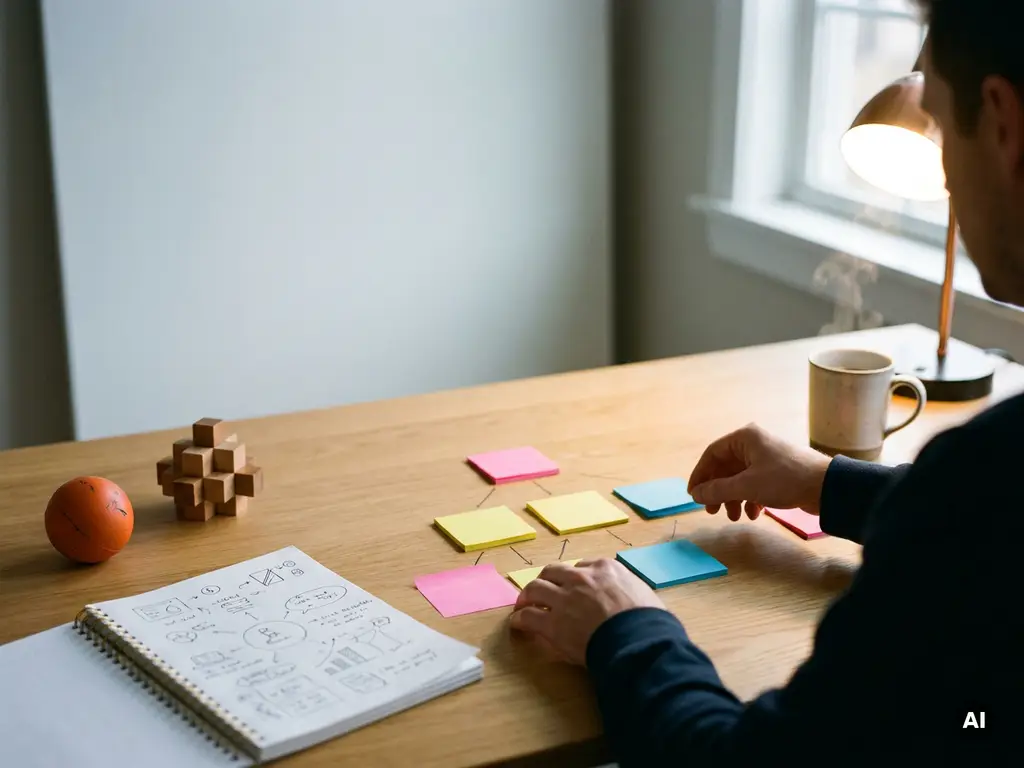
- Silent sticky note sprint: Everyone writes ideas silently first, then clusters themes together.
- Lightning decision matrix: After ideation, score top ideas on impact, effort, and risk to avoid “favorite idea” bias.
How do you run them in 20 minutes?
- Frame the problem in one sentence and define success.
- Generate silently for 5 to 7 minutes.
- Share by reading, not selling, to keep it neutral.
- Cluster similar ideas into themes.
- Select 1 to 3 ideas using simple scoring or dot voting.
If your team struggles with information overload, these formats help because they create a clear container: one question, one timer, one output.
Which individual habits and micro-routines strengthen creativity during the workday?
The strongest individual habits for workplace creativity are micro-routines that protect attention, feed your brain new inputs, and capture ideas before they disappear. Creative thinking improves when you alternate focused work with short recovery, keep a running idea system, and practice reframing problems into better questions.
- Two-question reframe: Replace “How do we fix this?” with “How might we make this easier for the user?” and “What would success look like in 2 weeks?”
- Idea capture loop: Keep one place for ideas, then review it for 3 minutes daily to combine and evolve them.
- Input snack: Spend 5 minutes on a new domain: a different industry, a customer call, a competitor flow. Novelty fuels connections.
- 90-second reset: Stand up, breathe, and change location. Small state changes often unlock new associations.
- One constraint per task: Add a creative boundary like “one slide only” or “explain in 30 seconds.” Constraints sharpen thinking.
When you feel stuck, do not push harder. Switch mode: write, sketch, or talk it out for two minutes, then return to the task with a smaller next step.
What team exercises build psychological safety for more creative collaboration?
Team exercises build psychological safety by making it normal to share unfinished ideas, ask questions, and recover quickly from mistakes. Psychological safety matters for creative collaboration because people will not take creative risks if they expect embarrassment or punishment. Simple routines that reward listening and support increase trust and idea flow.
Which team creativity activities create safer idea sharing?
- Yes, and round: In pairs, one person proposes an idea, the other responds with “Yes, and…” plus an addition. This trains building, not blocking.
- “I might be wrong” opener: Start discussions with one uncertainty each. It lowers status pressure and invites learning.
- Failure-to-learning swap: Each person shares one small mistake and what it taught them. Keep it practical, not personal.
How do you keep safety high during critique?
- Separate modes: Label time as “generate” or “evaluate.” No critique during generate mode.
- Critique the work, not the person: Use “The idea could be clearer if…” instead of “You didn’t…”
- Use a plus, delta close: One thing to keep, one thing to change next time.
Research on high-performing teams consistently points to psychological safety as a key predictor of performance. In practice, that means leaders model curiosity, teams practice supportive behaviors, and everyone gets a turn to contribute.
How can workshops and team-building formats accelerate creative thinking at work?
Workshops and team-building accelerate creative thinking at work by compressing practice into a focused environment with expert facilitation, clear constraints, and real-time feedback. Instead of hoping creativity appears in meetings, teams rehearse the behaviors behind it: listening, adapting, storytelling, and building on each other’s ideas.
Effective formats usually combine three elements: a shared language for collaboration, hands-on exercises that feel safe, and a concrete output like a clearer message, a stronger pitch, or a shortlist of testable ideas.
Hoe X helpt met creatieve denkoefeningen op het werk
Als je creatieve denkoefeningen structureel wilt inzetten, helpen wij teams om sneller ideeën te genereren, beter samen te werken en boodschappen te laten landen met energie en humor. We gebruiken improvisatie en storytelling om werkbare routines te trainen die je meteen meeneemt naar de werkvloer.
- Improv-oefeningen voor werk die luisteren, flexibiliteit en “build instead of block” versterken
- Teamsessies die psychologische veiligheid en open communicatie concreet maken in gedrag
- Storytellingtools om complexe plannen om te zetten in heldere, memorabele boodschappen
- Flexibele formats van 1 uur tot een volledige dag, passend bij jouw doelen en agenda
Bekijk onze workshops, ontdek team-buildingopties, of verken Positive Culture. Wil je sparren over wat het beste past bij jouw team? Neem contact op via Boom For Business en vraag een voorstel aan.
Frequently Asked Questions
How do I choose the right creative exercise for a specific problem?
Match the exercise to the stage of work. Use divergent tools (10-ideas sprint, SCAMPER, Crazy 8s) when you need options; use convergent tools (impact/effort/risk scoring, dot voting) when you need a decision. If the problem is fuzzy, start with a 2-minute reframe (“How might we…?”) before ideating.
What should we do if the team keeps generating ideas but nothing gets implemented?
Add a “test step” to every session: pick one idea, define a smallest experiment you can run in 48 hours, choose a success metric, and assign an owner. Put a 10-minute follow-up on the calendar to review results and decide: scale, tweak, or drop.
How can introverts or quieter teammates contribute more in creative sessions?
Default to silent generation first (brainwriting or sticky-note sprints) and share by reading, not pitching. Rotate facilitation, use round-robin sharing, and allow anonymous submissions for sensitive topics. These structures reduce pressure and increase idea diversity.
How do we run creative exercises in remote or hybrid meetings without losing energy?
Keep it highly structured: one prompt on screen, a visible timer, and a shared board (Miro, FigJam, Jamboard alternative) for silent input. Use short breakout pairs for “Yes, and” building, then return to cluster and vote. End by documenting the top idea + next test in the chat or notes.
How do we measure whether these creativity routines are actually working?
Track leading indicators weekly: number of ideas generated, number of small tests run, cycle time from idea to experiment, and participation spread (who contributed). Pair that with one outcome metric tied to your goal (e.g., conversion, time saved, customer satisfaction) to avoid “activity without impact.”
What are common mistakes that make creative exercises backfire—and how do we avoid them?
Common pitfalls are unclear prompts, mixing critique into ideation, and skipping the close. Avoid them by writing the problem in one sentence, labeling modes (“generate” vs “evaluate”), and always ending with a decision: top 1–3 ideas, a next step, and an owner. Also keep sessions short to prevent fatigue.
How often should we practice creative thinking exercises to see results?
Aim for 5–10 minutes, 3–5 times per week for individuals, or one 20-minute team sprint weekly. Consistency matters more than duration. Review what you tried every two weeks and swap in a new prompt if the routine feels stale.
Related Articles
- How often should you run team culture building sessions?
- What does creative thinking training at work actually change about how teams operate?
- How do you follow up after team building activities to sustain the impact?
- 7 leadership skills training formats that work for burned-out managers
- How does an event presenter engage audiences?