
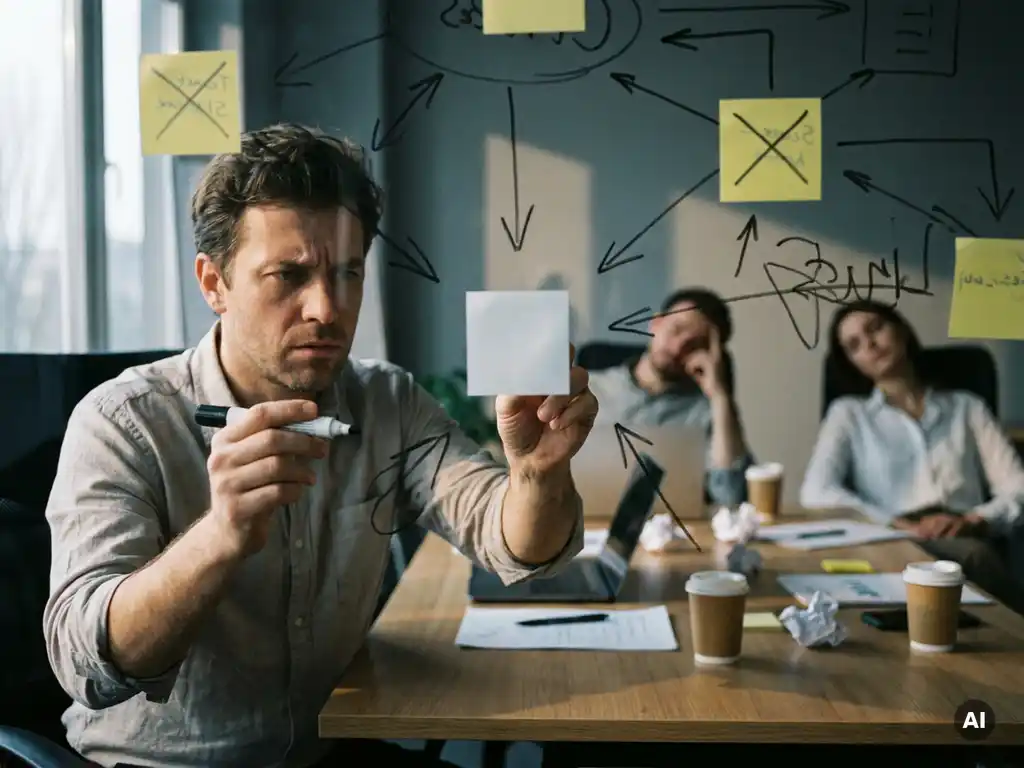
To fix a brainstorming session that is going nowhere, stop generating ideas and reset the conditions that make ideas possible: clarify the problem, change the pace, and switch to a structured method with clear roles and time boxes. Most stalled sessions recover within 10 to 20 minutes once the team shares the same target and a simple process.
This works because “stuck brainstorming” is rarely a creativity problem. It is usually a focus problem, a safety problem, or a facilitation problem that lets a few voices dominate while everyone else checks out.
The questions below break down why sessions stall and exactly how to restart team ideation, choose the right brainstorming techniques, and turn rough ideas into a next step.
Why do brainstorming sessions stall in the first place?
Brainstorming sessions stall when the group lacks a clear problem statement, psychological safety, or a shared process for building on ideas. The most common causes are vague goals, fear of judgment, one or two people dominating, and jumping to evaluation too early. Fixing the stall starts by diagnosing which of these is happening.
In practice, a “fix brainstorming session” moment usually shows up as silence, circular debate, or a flood of low-value ideas. Those symptoms point to a few root issues:
- Unclear prompt: “How do we improve X?” is too broad. People need constraints, audience, and success criteria.
- Mixed levels of context: Some participants know the background, others do not, so the group cannot build momentum together.
- Early judgment: The team starts ranking, poking holes, or defending ideas before enough options exist.
- Low safety: If people expect criticism, they self-censor, and team ideation collapses into safe, obvious suggestions.
- Wrong format for the problem: Open discussion is a poor tool for complex, ambiguous challenges without structure.
Once you name the cause out loud, you can choose a reset that matches it instead of pushing harder and hoping creativity appears.
How can you reset the room when ideas stop flowing?
Reset a stuck brainstorming session by pausing the discussion, restating the goal in one sentence, and switching to a short, structured activity that changes energy and participation. A fast reset includes a two-minute silent write, a quick share round, and a rule that no one evaluates ideas until a set time is up.
Use this simple reset sequence when the room goes flat:
- Call a clean pause: “Let’s take three minutes to reset.”
- Reframe the question: Write one specific prompt, such as “How might we reduce customer onboarding time by 20% without adding headcount?”
- Silent idea sprint: Everyone writes 5 to 10 ideas individually. Silence prevents groupthink and gives quieter thinkers space.
- Round-robin share: Each person shares one idea at a time. No commentary, only capture.
- Build, do not judge: Use “yes, and” language to add, combine, or extend ideas for one more round.
If energy is the issue, change something physical: stand up, move to a different wall, or split into pairs. If conflict is the issue, tighten the rules: one speaker at a time, time limits, and a visible parking lot for off-topic debates.
Which brainstorming techniques work best when a team is stuck?
The best brainstorming techniques for a stuck team are structured methods that reduce social pressure and force variety, such as brainwriting, Crazy 8s, SCAMPER, and reverse brainstorming. These techniques work because they create constraints, equalize participation, and produce more diverse options than open discussion.
Pick a technique based on what “stuck” looks like:
- Brainwriting 6-3-5: People write 3 ideas in 5 minutes, then pass them along for others to build on. Great for quiet rooms and mixed seniority.
- Crazy 8s: Eight quick sketches or headlines in eight minutes. Great when the team overthinks and needs speed.
- SCAMPER: Substitute, Combine, Adapt, Modify, Put to another use, Eliminate, Reverse. Great for improving an existing product, process, or event.
- Reverse brainstorming: Ask “How could we make this worse?” then invert the answers. Great when the team feels blocked or defensive.
- 1-2-4-All: Solo ideas, then pairs, then fours, then whole group. Great for building confidence and alignment.
For creative facilitation, the key is to time-box each round and visibly separate divergent thinking from convergent thinking. When teams mix the two, they stall.
How do you facilitate brainstorming so everyone contributes?
Facilitate brainstorming so everyone contributes by designing equal airtime into the process: start with silent ideation, use round-robin sharing, assign clear roles, and capture ideas visibly without judgment. Strong facilitation protects the group from hierarchy effects, interruptions, and premature evaluation, which are the main reasons participation drops.
These facilitation moves reliably increase contribution across personality types and seniority levels:
- Set ground rules in one minute: defer judgment, build on ideas, one conversation at a time, and aim for quantity first.
- Use a neutral facilitator: the facilitator manages process, not content, so the team can focus on thinking.
- Rotate who speaks first: avoid always starting with the most senior or most vocal person.
- Capture verbatim: write ideas as stated, not “improved,” so people feel heard.
- Invite the quiet explicitly: “We have not heard from two people yet. What are you seeing?”
- Protect minority ideas: ask for one “wild card” per person before narrowing.
If your organization struggles with communication fatigue, treat brainstorming as a communication moment, not just an ideation moment. People engage when they feel listened to and when the prompt is concrete.
How do you turn messy ideas into a clear next step?
Turn messy brainstorming output into a clear next step by clustering ideas into themes, choosing a decision criterion, and converting the best themes into testable actions with owners and deadlines. The goal is not to pick the perfect idea. The goal is to pick the next experiment or decision that reduces uncertainty fast.
Use this practical funnel right after team ideation:
- Cluster: group similar ideas into 3 to 7 themes and name each theme with a short label.
- Define criteria: choose 2 to 4 filters such as impact, effort, risk, and time to value.
- Dot-vote: each person gets a limited number of votes across themes, not individual ideas.
- Stress-test: for the top 2 themes, ask “What would have to be true for this to work?”
- Write the next step: convert the winner into a one-sentence action: “We will test X with Y audience by Z date.”
- Assign ownership: one owner, one support person, one check-in date.
This is where many sessions fail. They end on excitement but no commitment. A good facilitator ends with a decision, a calendar, and a shared definition of done.
How X helps with brainstorming sessions that go nowhere
When a brainstorming session goes nowhere, X helps by bringing a proven facilitation structure that boosts listening, flexibility, and idea building, so teams move from stuck to actionable. We use professional improv principles to create psychological safety, speed up team ideation, and turn rough input into clear outcomes that people actually support.
- Improv-based tools: practical “yes, and” habits that replace idea killing with idea building
- High-participation formats: hands-on exercises that balance airtime and reduce hierarchy effects
- Clear outputs: clustering and decision steps that turn messy ideas into a next action
- Culture impact: shared laughter that strengthens trust and supports a positive culture
- Flexible delivery: sessions from one hour to a full day, tailored to your challenge
If you want X to help your next session produce real decisions, explore our workshops, see how we support team building, or start the conversation at Boom For Business.
Frequently Asked Questions
How long should a brainstorming session be to avoid stalling?
Aim for 30–60 minutes of ideation, split into short rounds (5–10 minutes) with clear switches between diverging and converging. If you need more time, run two sessions: one for generating options, a second (later) for selecting and planning. Energy and focus usually drop after the first hour unless you change the activity or take a real break.
What should you send as pre-work so everyone starts with the same context?
Send a one-page brief 24–48 hours ahead: the problem statement, who the user/customer is, current baseline metrics, constraints (budget, timeline, tools), and what a “good outcome” looks like. Ask each person to bring 2–3 examples (competitors, analogies, past attempts) and one question they think the team must answer.
How do you handle a dominant voice without creating tension?
Change the process, not the person. Use silent writing first, then round-robin sharing with a strict “no commentary” rule. If needed, give the dominant participant a role (timekeeper or scribe) so they contribute while leaving space for others. If it continues, name the pattern neutrally: “Let’s hear two voices we haven’t heard yet before we respond.”
What’s the best way to brainstorm with remote or hybrid teams?
Use the same structure, but make it more explicit: a shared board (sticky notes), silent writing with cameras optional, and timed share-outs. Keep groups small (3–5 people) in breakout rooms, then merge themes in the main room. Assign one facilitator and one tech host so the session doesn’t stall on tools or turn-taking.
How do you decide which ideas to test first when everything feels promising?
Pick a simple prioritization lens before you vote: impact vs. effort, risk vs. learning value, or time-to-value. Then choose one “quick win” and one “high-learning” experiment. Write each as a test: hypothesis, smallest test, success metric, owner, and date—so the team leaves with momentum, not just favorites.
What if the problem is political or cross-functional, not creative?
Treat it as an alignment session first. Start by mapping stakeholders, decision rights, and constraints, then reframe the prompt into what the team can actually influence. Use a parking lot for unresolved conflicts and end with a clear decision path (who decides what, by when) so ideation doesn’t get stuck in debate.
How can you measure whether your brainstorming sessions are improving over time?
Track a few lightweight signals: participation balance (who spoke or contributed notes), number of testable next steps produced, cycle time from session to first experiment, and post-session confidence (“I know what we’re doing next,” 1–5). Review these monthly and adjust the format—small process tweaks compound quickly.