
Creative techniques produce better ideas in a brainstorming session when they deliberately widen the range of options first and then narrow to the strongest concepts using clear criteria. The most reliable approaches combine structured divergence, psychological safety, and fast iteration so people build on each other’s thinking instead of defending their first idea.
This works best when the group uses simple constraints, equal participation, and a facilitator who keeps momentum and protects idea flow. The techniques below focus on practical idea generation you can run in real meetings, not theory.
You will learn what makes brainstorming work, which creative thinking methods outperform classic free-for-all sessions, and how to facilitate step by step without common pitfalls.
What makes a brainstorming session produce better ideas?
A brainstorming session produces better ideas when it creates psychological safety, separates idea generation from evaluation, and gives everyone equal airtime through structure. High-quality group brainstorming happens when participants listen actively, build on ideas, and use constraints and prompts that push beyond obvious answers while keeping the goal clear.
In practice, better ideas come from three conditions working together.
- Clarity: A specific problem statement, a defined audience, and a success definition. Vague prompts create vague ideas.
- Safety: People must feel safe to suggest half-formed thoughts without getting corrected. This is where many teams stall.
- Structure: Time boxes, rounds, and written idea capture prevent the loudest voice from steering the room.
Finally, quality improves when you treat brainstorming as a pipeline. First you generate lots of options, then you cluster, then you test and refine. Trying to do all of that at once is the fastest way to get safe, predictable ideas.
Which creative techniques generate more and better ideas in groups?
The creative techniques that generate more and better ideas in groups are the ones that force breadth, reduce groupthink, and make participation visible. In most teams, structured brainstorming techniques like brainwriting, SCAMPER, and “yes, and” style building outperform open discussion because they produce more unique inputs and fewer premature judgments.
Use these creative thinking methods as a menu, not a religion. Pick one diverging technique and one converging technique per session.
- Brainwriting 6 3 5: Everyone writes ideas silently, then passes them along for others to build on. Great for group brainstorming with mixed seniority.
- Crazy 8s: Eight quick sketches or headlines in eight minutes. Speed prevents overthinking and surfaces surprising angles.
- SCAMPER: Substitute, Combine, Adapt, Modify, Put to another use, Eliminate, Reverse. A reliable prompt set for product, process, and communication ideas.
- “Yes, and” rounds: For two minutes, every response must add to the previous idea. This trains additive thinking and keeps momentum.
- Worst possible idea: Generate intentionally bad solutions, then flip them into useful opposites. This breaks fear of being wrong.
- Constraint prompts: “Do it in 24 hours,” “with half the budget,” or “for a skeptical audience.” Constraints often increase originality.
To improve idea generation further, combine techniques. For example, start with brainwriting to get volume, then use SCAMPER on the top clusters to deepen them.
How do you run a brainstorming session step by step for higher-quality ideas?
Run a brainstorming session step by step by setting a sharp question, generating ideas silently first, sharing in structured rounds, clustering themes, and then selecting winners with clear criteria. This facilitation approach improves idea quality because it protects divergence early and creates a fair, transparent path to convergence and next actions.
- Define the challenge in one sentence: Include the target audience and the moment of use. Example: “How might we explain the new strategy so frontline teams can act on it next week?”
- Set rules and time boxes: No evaluating during idea generation, build on ideas, and keep contributions short.
- Warm up creativity: A two-minute prompt like “name ten uses for a paperclip” lowers self-consciousness and speeds up thinking.
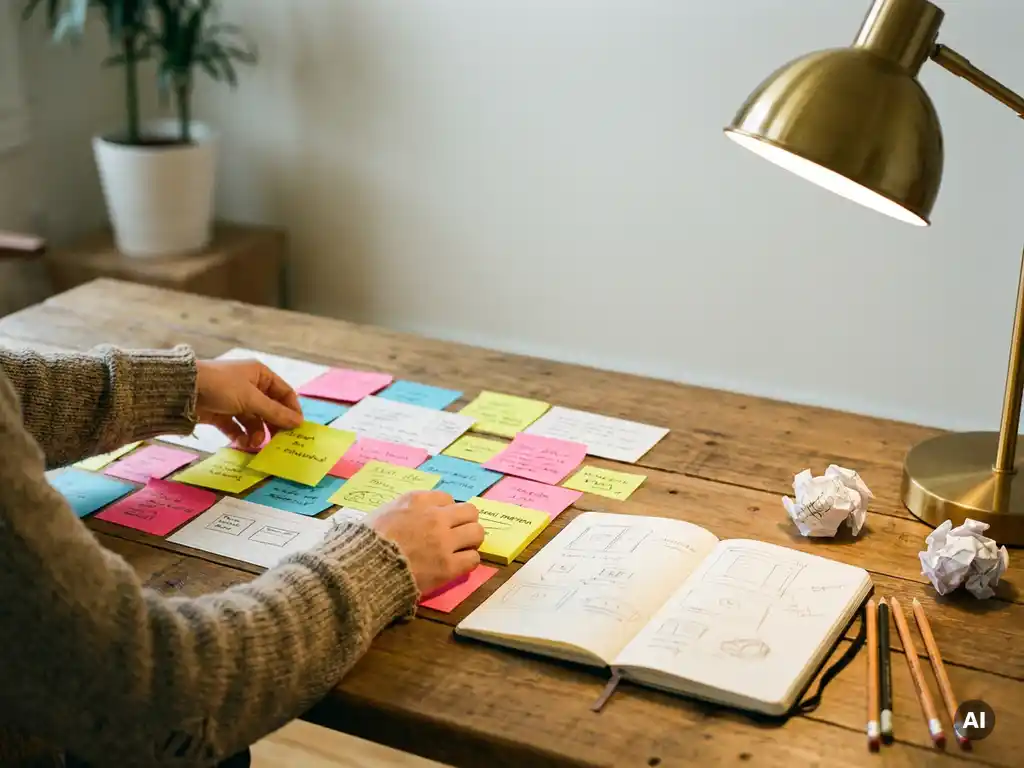
- Silent idea generation first: Use sticky notes or a shared doc. Silent rounds reduce anchoring and help introverts contribute.
- Structured sharing: Go round-robin. Each person shares one idea at a time until the pool is visible.
- Cluster and label: Group similar ideas and name the themes. This turns chaos into options.
- Enrich the best clusters: Apply SCAMPER or “yes, and” to the top two or three themes to make them stronger.
- Select with criteria: Vote using impact versus effort, strategic fit, and speed to test. Avoid choosing only what feels familiar.
- Assign next steps: Turn the top ideas into experiments with an owner, a deadline, and a success signal.
If you want higher-quality outcomes, end with a short pre-mortem: “What would make this idea fail in the real world?” Then adjust before you leave the room.
What are common brainstorming mistakes and how can you fix them?
Common brainstorming mistakes include starting with open discussion, evaluating ideas too early, letting senior voices dominate, and leaving without decisions. Fix them by using written idea generation, separating divergence from convergence, rotating airtime, and translating top ideas into experiments. Better facilitation tips create fairness, speed, and stronger ideas.
Here are the most frequent failure points and practical fixes.
- Mistake: “Let’s just talk” as the method.Fix: Park concerns in a “risks” column and return during the selection phase.
- Mistake: One person becomes the editor of every idea.Fix: Rewrite the question until it names the audience, goal, and constraint.
- Mistake: Too many ideas, no synthesis.Fix: Assign owners and define the smallest test you can run within one or two weeks.
One more subtle issue is energy. If the room feels flat, idea generation drops. Short time boxes, quick rounds, and playful prompts often restore momentum without sacrificing professionalism.
How does Boom For Business help with brainstorming sessions?
We help teams run brainstorming sessions that produce clearer, braver, and more usable ideas by combining professional facilitation with practical improvisation and storytelling tools. Instead of relying on unstructured discussion, we create a process that increases participation, strengthens listening, and turns raw ideas into messages and actions people actually remember.
- Improv-based structure that trains “yes, and” collaboration so ideas build instead of stall
- Facilitation that protects psychological safety so more voices contribute, not just the loudest
- Story-driven shaping that turns scattered concepts into a compelling narrative teams can present
- Flexible formats from short sessions to deeper programs depending on your goal and timeline
If you want your next session to generate stronger ideas and real follow-through, contact us via Boom For Business or explore our workshops, team building, and positive culture programs to request a quote.
Frequently Asked Questions
How many people should be in a brainstorming session for best results?
Aim for 4–8 active participants. Fewer than 4 limits variety; more than 8 reduces airtime and increases coordination overhead. If you need broader input, run multiple small sessions or use asynchronous brainwriting first, then bring a smaller group together to cluster and select.
How long should a brainstorming session last to stay productive?
Plan 45–90 minutes for a single focused question. A practical split is: 5–10 minutes to frame the challenge and rules, 10–20 minutes for silent generation, 15–25 minutes for sharing and clustering, and 10–20 minutes for selection and next steps. If you have multiple questions, run separate time-boxed rounds rather than one long discussion.
What should we do if the group gets stuck or ideas feel repetitive?
Change the prompt, not the people. Try a quick constraint (“half the budget,” “24 hours,” “for first-time users”), switch formats (from talking to writing/sketching), or use a perspective shift (“How would a competitor solve this?” “How would we do it if we couldn’t use our current channel?”). Then restart with a fresh 5-minute silent round.
How do you brainstorm effectively with remote or hybrid teams?
Use a shared whiteboard or doc with one idea per sticky/note, and keep cameras optional to reduce fatigue. Start with silent brainwriting (everyone types at once), then do round-robin reads to equalize airtime. Assign a co-facilitator to manage the tool, capture decisions, and watch the chat so the facilitator can focus on flow.
How do we choose the right evaluation criteria without killing creativity?
Decide criteria after clustering, before voting, and keep it to 2–4 items. Common sets are: impact on the target audience, effort/cost, speed to test, and strategic fit. Phrase criteria as questions (“Will this change behavior next week?”) and score quickly; save detailed debate for the top 2–3 ideas only.
How can we turn the winning ideas into action immediately after the session?
End by converting each top idea into a small experiment: define the first deliverable, an owner, a deadline (ideally 7–14 days), and a success signal (what you’ll measure or observe). Schedule a 15-minute follow-up before people leave the room, and capture decisions in a single page so momentum doesn’t evaporate.
Who should facilitate, and what if the team has strong hierarchy?
Choose a neutral facilitator who isn’t the decision-maker for the outcome. In hierarchical groups, use more writing-based methods (brainwriting, anonymous notes) and strict round-robin sharing. Ask senior leaders to speak last during sharing and voting, and make the selection method transparent (e.g., dot-voting plus criteria) to reduce deference bias.