
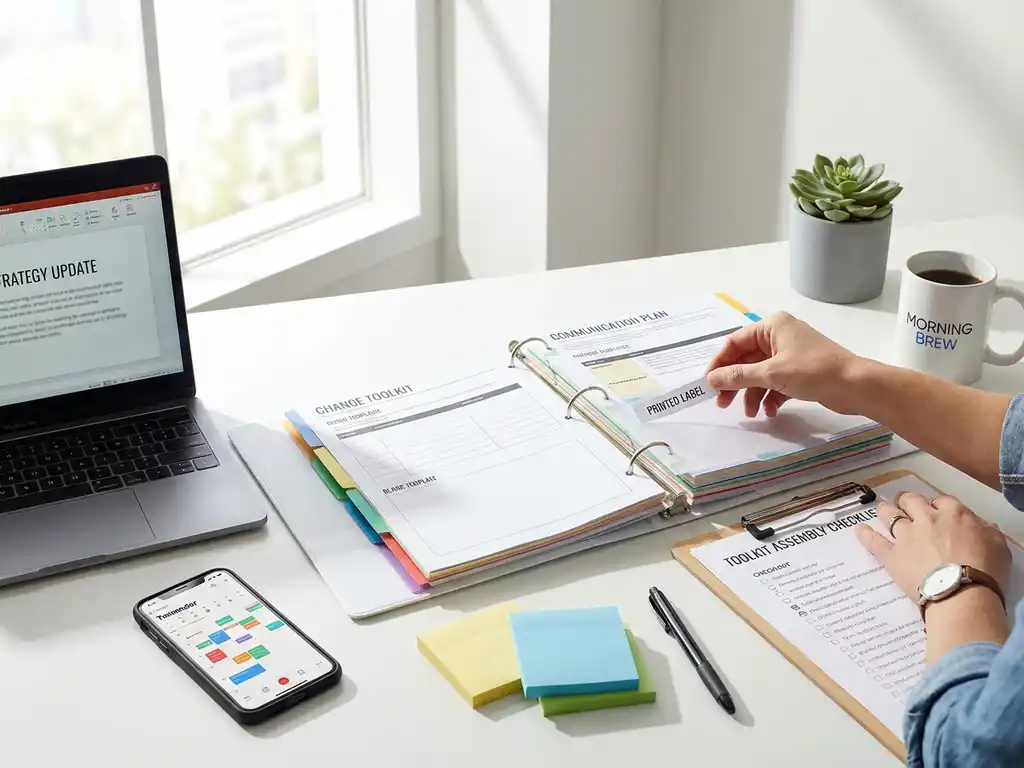
A change communication toolkit for managers is created by defining the change story, aligning leaders on a single communication strategy, and giving managers ready to use change communication tools for meetings, 1:1s, and follow ups. The best toolkits combine clear messages, practical templates, and coaching so managers can lead through change confidently.
This matters most when teams face workplace transformation, cultural change, or new ways of working, because managers become the main translators of strategy into daily reality. A strong internal communication strategy reduces confusion, boosts employee engagement, and protects team culture during uncertainty.
Below are the key questions managers and communication leads ask, with step by step answers you can apply immediately.
What is a change communication toolkit for managers?
A change communication toolkit for managers is a practical set of messages, templates, and routines that helps managers communicate change clearly and consistently. It supports leading through change by turning a high level communication strategy into simple actions for team meetings, 1:1s, and ongoing employee communication training moments.
Think of it as the bridge between leadership intent and day to day conversations. Instead of asking managers to improvise every update, the toolkit gives them a shared narrative, approved language, and flexible formats that still sound human.
- Purpose: reduce confusion, rumors, and communication fatigue
- Outcome: higher trust and employee engagement through clarity and repetition
- Best use: reorganizations, strategy shifts, culture building initiatives, and new processes
How do you build a change communication toolkit step by step?
Build a change communication toolkit by starting with the change story, then translating it into manager ready assets, and finally training managers to deliver it with confidence. The most effective approach treats the toolkit as part of management training and change management training, not just a document you email once.
- Clarify the change in one page: what is changing, why now, what stays the same, and what success looks like.
- Define audiences and moments: map who needs what information, when, and through which channels.
- Create a message architecture: one core narrative, three to five key messages, and proof points that support them.
- Anticipate questions: build an FAQ that includes tough questions, tradeoffs, and what is still unknown.
- Turn messages into tools: meeting agendas, 1:1 prompts, email drafts, and short talking points.
- Align leadership: confirm what managers can say, what they cannot, and how to handle uncertainty.
- Run a manager rehearsal: practice delivery, tone, and handling pushback using real scenarios.
- Set a feedback loop: collect questions from managers weekly and update the toolkit as the change evolves.
If you want the toolkit to drive culture transformation, add a simple behavior layer: what leaders and teams should do differently, not only what they should know.
What should a change communication toolkit include?
A complete change communication toolkit includes a clear narrative, consistent talking points, and practical templates managers can use immediately. It should also include change communication tools for listening and feedback, because employee engagement increases when people can respond, not just receive updates.
- Change narrative: the story of why the change matters, written in plain language and grounded in reality.
- Key messages and proof points: short statements managers can repeat, plus examples that make them believable.
- FAQ and objection handling: answers to likely concerns, including what is unknown and when updates will come.
- Meeting kit: a team meeting agenda, discussion questions, and a closing summary managers can reuse.
- 1:1 conversation guide: prompts for motivation, workload, wellbeing, and role clarity.
- Channel templates: email drafts, chat posts, and short update scripts for recurring moments.
- Escalation paths: where managers send sensitive questions, risks, or employee relations issues.
- Measurement checklist: simple signals to track understanding, sentiment, and adoption over time.
For culture building and team culture building, include a short section on desired behaviors and team agreements, so the toolkit supports company culture, not just project delivery.
How do managers use the toolkit in team meetings and 1:1s?
Managers use the toolkit by repeating the core story, inviting questions, and translating the change into local impact for their team. In team meetings, the toolkit provides structure and consistency. In 1:1s, it provides coaching prompts that help managers address individual concerns while staying aligned with the internal communication strategy.
How to use the toolkit in team meetings
- Open with the headline: one sentence on what is changing and why it matters now.
- Share what is known and unknown: say what is decided, what is in progress, and when the next update comes.
- Make it local: explain the impact on priorities, workflows, and collaboration across departments.
- Run a short discussion: use two to three prompts from the toolkit to surface concerns early.
- Close with next steps: recap actions, owners, and where to send follow up questions.
How to use the toolkit in 1:1s
- Start with listening: ask what the person has heard and what worries them most.
- Connect to role clarity: discuss what changes in responsibilities, expectations, or timelines.
- Address emotion and motivation: acknowledge uncertainty and focus on what the person can control.
- Agree on one action: a small next step that supports adoption and reduces overwhelm.
Used this way, the toolkit becomes ongoing employee communication training in practice, not a one time announcement.
How do you keep change messages consistent without sounding scripted?
Keep change messages consistent by standardizing the meaning, not the exact wording. Managers should share the same core narrative, key messages, and boundaries, then personalize examples and tone to fit their team culture. This approach protects accuracy while avoiding robotic delivery, especially during cultural change and workplace transformation.
- Use a message spine: one story arc managers follow: why, what, how, and what happens next.
- Allow controlled flexibility: give two to three approved ways to explain each key message.
- Teach storytelling in change: encourage managers to use real, relevant examples from daily work.
- Set rules for uncertainty: provide exact phrases for unknowns, timelines, and decision ownership.
- Practice with pushback: role play tough questions so managers stay calm and clear.
When appropriate, humor in business can help reduce tension and improve recall, but it should stay business friendly and never minimize real concerns. Used well, it supports creative change management by making messages more human and easier to repeat.
How Boom for Business helps with change communication toolkits for managers
We help teams build change communication toolkits that managers actually use by combining clear messaging with practical rehearsal, business friendly humor, and improv based communication skills. Our approach strengthens communication strategy and internal communication strategy while protecting company culture during cultural change.
- Toolkit design support: we help shape the change story, key messages, and manager ready templates.
- Manager enablement: interactive change management training and management training so managers can lead through change with confidence.
- Skills that stick: workshops that build storytelling in change, listening, and handling tough questions without sounding scripted.
- Culture focus: company culture workshop formats that support team culture building and long term culture building behaviors.
If you want a toolkit that lands with clarity and energy in 2026, start with Boom For Business and explore our workshops to turn your next change into communication people remember and act on.
Frequently Asked Questions
How often should you update a change communication toolkit during a transformation?
Treat it as a living asset. Update it on a predictable cadence (weekly during high uncertainty, biweekly or monthly once things stabilize) and immediately after major decisions. Keep a simple version history and highlight “what changed since last time” so managers can scan fast.
What should managers do when employees ask questions they cannot answer yet?
Use a consistent “acknowledge + boundary + next step” response: acknowledge the concern, state what is known and what is not decided, and give a clear next update point or escalation path. Capture the question, share it through the agreed channel, and follow up even if the answer is still “no change yet.”
How can you tailor messages for different teams without creating misalignment?
Standardize the core narrative and key messages, then localize only the examples and implications. Provide a short “local impact worksheet” (what changes in priorities, workflows, stakeholders, and success measures) and require managers to stay within approved boundaries for timelines, roles, and policy.
What are practical ways to measure whether the change communication is working?
Combine leading and lagging signals: pulse questions on understanding and confidence, meeting/1:1 question volume and themes, adoption metrics (process usage, training completion), and sentiment indicators (eNPS comments, attrition risk flags). Review trends weekly and adjust messages where confusion persists.
How do you support remote or hybrid teams with a manager communication toolkit?
Design for asynchronous first: provide short written scripts, a 3–5 minute video option, and a meeting agenda that works across time zones. Add guidance for chat etiquette, how to handle silence on video calls, and a follow-up template that summarizes decisions and open questions.
What’s the minimum viable toolkit a small organization can launch quickly?
Start with five items: a one-page change story, 3–5 key messages with proof points, a short FAQ for tough questions, a 30-minute team meeting agenda, and a 1:1 prompt list. Run one rehearsal with managers, then iterate based on the questions they receive.
Related Articles
- How do you build an ownership mentality within a team?
- How do you run a collaborative team workshop for a group that struggles to agree?
- How do you deliver an elevator pitch when you only have 60 seconds?
- How does a corporate event host work?
- How do you integrate team building into change management strategies?