
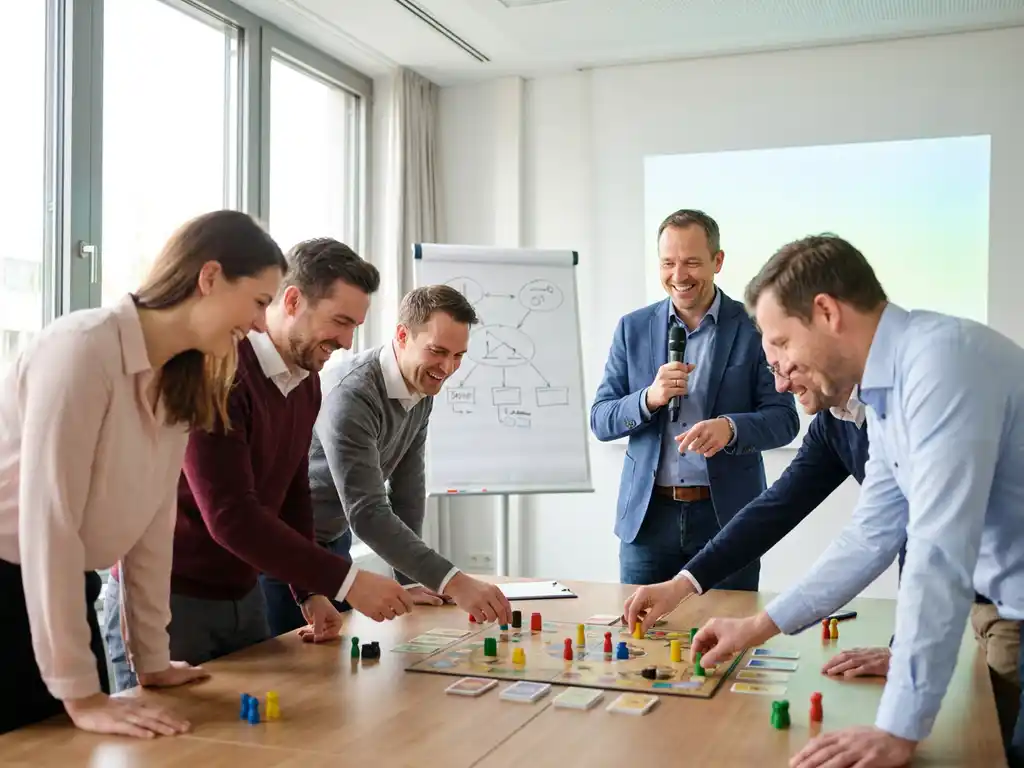
Combine training and entertainment in corporate events by designing one integrated experience where every “fun” moment reinforces a specific skill, message, or behavior. The most reliable formula is clear learning goals, interactive practice, and a host-led flow that keeps energy high while still delivering management training and employee communication training that sticks.
This approach works especially well for change management training, internal communication strategy rollouts, and company culture initiatives because people remember what they actively do and feel, not what they passively hear. When you add business-friendly humor and storytelling in change, you reduce resistance and increase employee engagement without watering down the content.
The questions below break down how to plan edutainment, choose formats, keep attention, and measure both learning and enjoyment.
What does “edutainment” mean in corporate events?
Edutainment in corporate events means blending education and entertainment so participants learn by doing, reflecting, and interacting while staying genuinely engaged. In practice, it combines training outcomes like leading through change or communication strategy skills with energizing elements like humor in business, storytelling, and facilitated participation.
In 2026, edutainment is less about adding a comedian to a conference and more about designing a learning journey that feels like an experience. The “entertainment” is not decoration. It is a delivery method that helps people absorb complex topics such as cultural change, workplace transformation, and organizational culture training.
- Education side: clear behaviors to practice, shared language, and change communication tools people can use immediately
- Entertainment side: surprise, emotional connection, and momentum that keeps attention through longer sessions
- Integration: every laugh, story, or activity points back to a learning goal
How do you set clear learning goals without making the event feel like a lecture?
Set learning goals by defining 2 to 4 observable behaviors participants should do differently after the event, then design short practice loops around them. When goals focus on action, not theory, the session feels like a company culture workshop or management training lab rather than a lecture.
Start with the business moment you are in: a cultural change program, a new internal communication strategy, or a shift in team culture building. Then translate that into behaviors that can be practiced live.
- Write goals as behaviors: “Give feedback using a shared structure” beats “Understand feedback”
- Limit the scope: fewer goals, more repetition, better retention
- Build a before and after: show what the “old way” looks like, then rehearse the “new way”
- Use real scenarios: leadership updates, cross-team handoffs, or change communication moments
This approach supports creative change management because it makes the change concrete. People leave with language and habits they can apply the next day.
Which interactive formats work best to blend training and fun?
The best interactive formats blend training and fun by encouraging safe participation, fast feedback, and shared reflection. Formats that work especially well for change management training and culture building include improv-based exercises, scenario role play, and facilitated storytelling because they turn abstract ideas into lived experiences.
Choose formats based on your audience size, psychological safety level, and the complexity of the message. For example, a culture transformation workshop often needs more reflection and discussion than a high-energy kickoff.
- Guided improv exercises: practice listening, adaptability, and collaboration under light pressure
- Scenario simulations: rehearse leading through change conversations and manager cascades
- Interactive panels: collect live questions and model transparent communication
- Storytelling sprints: teams craft short stories that connect strategy to daily work, supporting storytelling in change
- Culture labs: small groups define “how we work here” behaviors to strengthen team culture
A simple rule: if participants can predict the next 10 minutes, energy drops. Rotate formats every 8 to 12 minutes to keep attention and improve employee engagement.
How do you keep everyone engaged during training segments?
Keep everyone engaged during training segments by designing frequent participation moments, using humor and storytelling to maintain emotional connection, and making the content personally relevant. Engagement rises when people speak, decide, and practice, not when they only listen, especially during employee communication training and organizational culture training.
Engagement is not just volume or laughter. It is sustained attention plus a willingness to contribute. That matters most when you are tackling culture building or workplace transformation, where skepticism can be high.
- Use “micro participation”: quick polls, paired shares, or one-sentence reflections every few minutes
- Normalize low-risk contributions: start with easy prompts before asking for opinions on cultural change
- Make it specific: tie examples to real meetings, inbox overload, and cross-department friction
- Balance energy: alternate high-energy activities with calm reflection so introverts stay included
- Use business-friendly humor: laugh at recognizable situations, then pivot to the skill or tool
When you treat attention as a design constraint, training stops feeling like “content delivery” and starts feeling like a shared experience.
How do you measure whether the event delivered both learning and enjoyment?
Measure learning and enjoyment by combining three signals: skill uptake, behavior intent, and participant experience. The most practical method is a short pre- and post-check on confidence or capability, plus follow-up evidence that people used the change communication tools or habits introduced during the event.
Enjoyment matters because it predicts whether people will recommend the session and stay open to future messages. Learning matters because it predicts whether your communication strategy and culture goals actually move.
- Immediate learning check: ask participants to name one tool they will use and where
- Confidence shift: quick rating before and after on leading through change conversations
- Manager observation: a simple checklist for new behaviors in meetings or updates
- Follow up pulse: 2 to 4 weeks later, ask what stuck and what got in the way
- Experience score: ask about relevance, pacing, and psychological safety, not just “Did you like it?”
If you can capture one concrete behavior change and one clear emotional takeaway, you have strong evidence the edutainment approach worked.
How Boom for Business helps with combining training and entertainment in corporate events?
We combine training and entertainment by using professional hosting, improvisation, and custom storytelling to turn serious goals like change management training, internal communication strategy, and company culture into interactive moments people remember and repeat. We keep the tone business-appropriate while using humor in business to lower resistance and boost employee engagement.
- Custom-built programs: tailored to your cultural change, management training needs, and audience reality
- Interactive formats: improv, scenario practice, and culture building exercises that create real skill uptake
- Strong facilitation: clear structure, inclusive participation, and energy management across the room
- Workshops and masterclasses: practical employee communication training and organizational culture training that teams can apply immediately
If you want an event that lands key messages and feels genuinely fun, start by exploring Boom For Business and our workshops for teams, then contact us to design an edutainment format that fits your goals, audience, and timeline.
Frequently Asked Questions
How long should an edutainment segment be, and how do you build a full agenda around it?
Design in short blocks: 8–12 minutes per activity, then a quick debrief. For a 60–90 minute session, plan 4–6 rotations (activity → reflection → takeaway). For half-day events, add longer “practice labs” (20–30 minutes) after every 2–3 high-energy segments to convert fun into usable habits.
How do you adapt edutainment for remote or hybrid corporate events?
Use formats that work on camera: chat-based prompts, breakout role plays with clear scripts, and quick polls every 5–7 minutes. Keep instructions visual (one slide), assign a co-host to manage chat, and shorten activities by ~20% to account for tech friction. In hybrid rooms, prioritize audio quality and give remote participants a dedicated turn-taking method (queue, hand-raise, or moderator).
What should you do if your audience is skeptical or “not into fun” at work?
Start with credibility and choice. Open with the business reason for the session, then use low-risk participation (anonymous polls, paired discussion) before any public performance. Frame activities as rehearsal for real conversations, not games. Also, make opting out safe: allow roles like observer/timekeeper so people can contribute without being put on the spot.
How do you ensure humor stays inclusive and business-appropriate?
Set clear boundaries: no jokes about protected characteristics, personal appearance, or individual employees. Use “situational humor” (recognizable work moments) and always punch up at systems, not people. Pre-brief leaders on tone, and test stories with a diverse internal review group when the topic is sensitive (e.g., restructuring or layoffs).
What materials or follow-up should participants receive so the learning sticks?
Send a one-page “toolkit” within 24 hours: the 2–4 behaviors, a simple script/template (e.g., change update structure), and one practice prompt for the next team meeting. Add a 10-minute manager guide with observation cues and a two-week reminder cadence (email or Slack) to prompt real-world use.
How do you choose the right facilitator or vendor for an edutainment-style event?
Ask for proof of learning design, not just performance clips. Request a sample run-of-show, how they handle psychological safety, and how they measure behavior change. Look for customization depth (your scenarios, your language), co-facilitation capability for large groups, and references from similar change or culture initiatives.
Related Articles
- How do you address tensions within a team through training?
- How do you train managers to stop waiting for instructions?
- 7 team building activities that strengthen trust between departments
- What are the differences between indoor and outdoor team building?
- What is the ROI of professional event hosting services?