
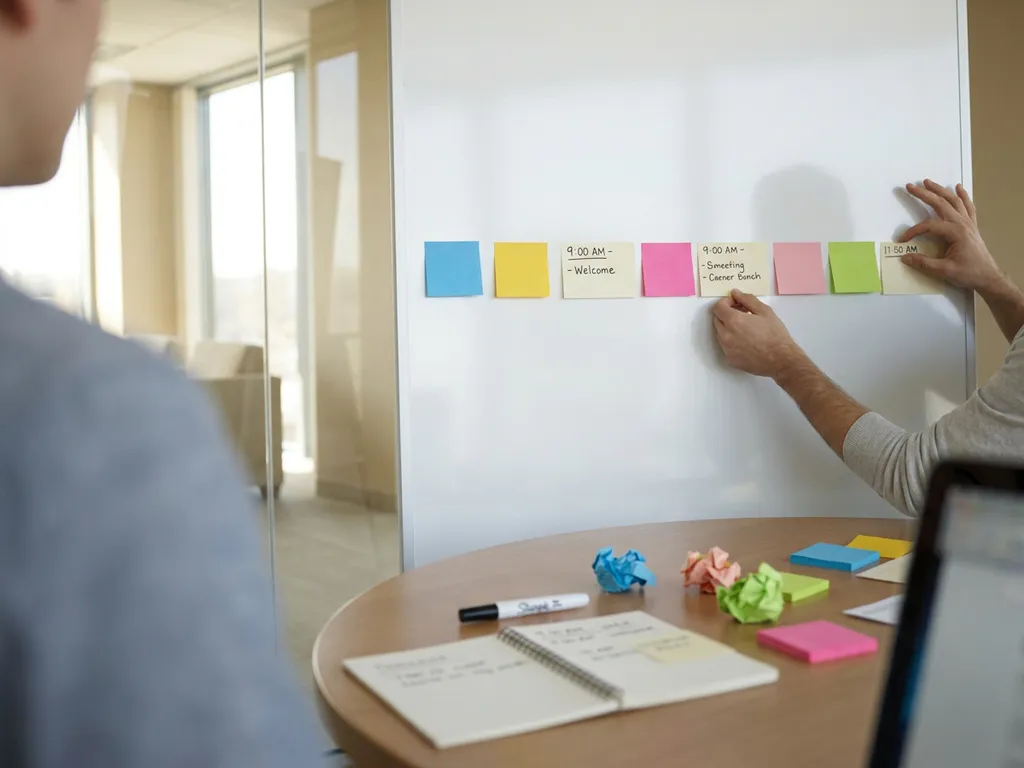
A strong company culture workshop agenda is a time-boxed plan that moves from shared context to honest diagnosis to clear commitments, with facilitation methods that keep everyone participating. It should balance discussion with decision making, and end with owners, timelines, and change communication tools people will actually use.
The best agendas work because they connect culture building to real work: leadership behaviors, team culture norms, and the internal communication strategy that reinforces them. They also create psychological safety so mixed stakeholders can speak candidly without the session turning into a debate.
The questions below break down how to design, run, and improve a culture transformation workshop that supports employee engagement and workplace transformation.
What is a company culture workshop agenda?
A company culture workshop agenda is a structured sequence of activities that helps a group define, assess, and improve company culture in a set amount of time. It typically includes alignment on purpose, exploration of current team culture, prioritization of cultural change, and concrete next steps for a cultural change program and internal communication strategy.
Think of it as the operating system for the session. Without an agenda, culture conversations drift into opinions and anecdotes. With a clear agenda, you can turn values and behaviors into observable norms, decision rules, and practical rituals that support team culture building.
A good agenda also makes facilitation easier by answering three questions upfront:
- What decisions must we make today? For example, which behaviors to start, stop, and continue.
- What evidence will we use? Examples from projects, customer feedback, and internal communication patterns.
- How will we sustain it? Reinforcement through management training, employee communication training, and ongoing change communication tools.
How do you set goals and outcomes for a culture workshop?
Set goals and outcomes by defining the culture shift you need, the behaviors that prove it is happening, and the decisions the workshop must produce. The clearest company culture workshop goals are specific, measurable through observation, and tied to business realities like collaboration, speed, quality, and employee engagement during workplace transformation.
Start with a simple outcomes ladder that keeps the session practical:
- Outcome 1: Shared language for the current organizational culture and the desired team culture.
- Outcome 2: Behavior commitments that leaders and teams can practice immediately.
- Outcome 3: Reinforcement plan that connects to your communication strategy and change management training.
Then pressure-test your outcomes with two checks:
- Decision check: If the workshop ends, can you point to 3 to 5 decisions made, not just insights gained?
- Monday morning check: Can a manager describe what to do differently in the next team meeting?
If you are running a culture transformation workshop during a reorg, merger, or strategy shift, add a change communication outcome: what leaders will say, what channels you will use, and how you will handle questions consistently.
How do you structure a culture workshop agenda step by step?
Structure a culture workshop agenda by moving through five phases: align on purpose, surface reality, define the target culture, choose priorities, and lock in actions with owners and follow up. This step-by-step flow keeps culture building grounded in evidence, prevents circular debate, and supports leading through change with clear commitments.
- Opening and safety (10 to 15 minutes): set rules for candor, confidentiality, and participation.
- Context and intent (10 minutes): clarify why culture matters now and what decisions are in scope.
- Current culture diagnosis (30 to 45 minutes): gather examples of behaviors, meetings, and communication patterns.
- Desired culture definition (30 to 45 minutes): translate values into observable behaviors and team norms.
- Prioritize the shift (20 to 30 minutes): pick 2 to 3 behavior changes with the biggest impact.
- Action planning (30 minutes): owners, timelines, rituals, and change communication tools.
- Close and commit (10 minutes): each stakeholder states one commitment and one support needed.
For a 90 minute session, compress the diagnosis and definition steps and focus on one priority. For a half day, add deeper storytelling in change moments: participants share short stories of when the culture helped or hurt outcomes, then extract the behaviors behind those stories.
Which activities work best in a company culture workshop?
The best company culture workshop activities make culture visible and actionable: they turn abstract values into specific behaviors, reveal gaps between leadership intent and employee experience, and create commitments that improve employee engagement. High-impact activities include behavior mapping, scenario practice for change communication, and small group exercises that reduce hierarchy effects.
- Culture moments mapping: Teams list moments that shape culture most, such as onboarding, meetings, feedback, and decision making, then redesign one moment.
- Start stop continue behaviors: Participants propose behaviors to start, stop, and continue, then vote on the top priorities for culture building.
- Values to behaviors translation: Convert each value into 3 observable actions and 3 anti-behaviors, so management training can reinforce the same standards.
- Scenario role practice: Practice tough moments like missed deadlines, cross-team conflict, or strategy changes, using change communication tools and consistent language.
- Storytelling in change: Leaders and employees craft a short narrative about the change, focusing on what stays, what shifts, and what support exists.
If you want to incorporate humor in business, use it as a facilitation tool, not a distraction. Light, business-friendly humor can lower defensiveness, help people name awkward truths, and keep energy high during creative change management discussions.
How do you facilitate a culture workshop with mixed stakeholders?
Facilitate mixed stakeholder culture workshops by designing for psychological safety, balancing airtime, and separating exploration from decision making. When leaders, managers, and employees share a room, you need clear rules, structured turn taking, and neutral prompts so people can discuss cultural change honestly without fear of consequences.
Use these facilitation moves to keep the session productive:
- Start with equal voice formats: silent writing, small groups, and round robins before open discussion.
- Name power dynamics: agree that rank does not equal correctness, and that examples matter more than opinions.
- Use evidence prompts: ask for specific moments, not general statements, to reduce blame and increase clarity.
- Park and resolve: capture out-of-scope issues in a parking lot, then assign owners to follow up.
- Close the loop: end with a communication strategy for what will be shared, by whom, and when, so the workshop does not feel like a one-off.
For change management training contexts, align leaders first on what they can promise and what is still unknown. That prevents mixed messages and supports a credible internal communication strategy during workplace transformation.
How Boom for Business helps with company culture workshop agendas?
We help teams design and run a company culture workshop agenda that stays practical, high energy, and aligned to real organizational goals, especially during cultural change and workplace transformation. We combine facilitation, storytelling in change, and business-friendly humor so mixed groups engage honestly, make decisions faster, and leave with clear actions that support your communication strategy.
- Agenda design that drives outcomes: a step-by-step flow from diagnosis to commitments, with time boxes and decision points.
- Facilitation that boosts employee engagement: interactive formats that balance voices across leadership and teams.
- Change communication tools that stick: practical language, scenarios, and follow-up rhythms that reinforce culture building.
- Skill building options: workshops that strengthen communication, collaboration, and leading through change through applied practice.
If you want a culture transformation workshop that feels human and delivers clear next steps, visit Boom For Business or explore our workshops to plan your agenda and facilitation approach.
Frequently Asked Questions
How many people should attend a company culture workshop?
Aim for 8 to 16 participants for a single workshop so you can hear diverse perspectives without losing speed. If you need broader input, run multiple sessions by function/level and synthesize themes, or use a representative “culture council” plus a wider survey for validation.
What should we do before the workshop to make the discussion evidence-based?
Collect lightweight inputs 1 to 2 weeks ahead: a short pulse survey (5–8 questions), 3–5 recent project retrospectives, customer feedback themes, and a few anonymized examples of “culture moments” (meetings, decisions, onboarding). Share a one-page pre-read with the purpose, what’s in/out of scope, and the decisions you need to make.
How do we measure whether the culture changes actually stick after the workshop?
Track a small set of leading indicators tied to behaviors, not slogans. Examples: meeting start/stop times, decision turnaround time, frequency/quality of feedback, cross-team handoff defects, and manager 1:1 consistency. Review monthly for 90 days, and pair metrics with quick qualitative check-ins (“What behavior changed? What got in the way?”).
How do we handle sensitive topics (trust, conflict, burnout) without the workshop becoming a complaint session?
Use clear boundaries: focus on specific incidents and patterns, not naming or blaming individuals. Time-box “reality surfacing,” then move to “what would good look like” and “what will we do next.” If serious issues emerge (harassment, safety, ethics), pause and route them to the proper HR/legal process rather than trying to solve them in the room.
What’s the best follow-up cadence after a culture workshop?
Set a 30-60-90 day rhythm: within 48 hours share a summary and the 2–3 priorities; at 30 days review early wins and blockers; at 60 days reinforce through manager toolkits and team rituals; at 90 days reassess and decide what to scale or stop. Assign an owner for each commitment and schedule the check-ins before the workshop ends.
Can we run a culture workshop remotely or in a hybrid format?
Yes—use shorter blocks (60–90 minutes) with breaks, and rely on structured participation: silent writing, small breakout groups, and dot-voting. Use a shared board for behavior mapping and action plans, and appoint a co-facilitator to manage chat, time, and tech so the lead facilitator can focus on the group.
How do we turn workshop outputs into an internal communication plan people will actually read?
Translate decisions into three assets: a one-page “what’s changing/what’s staying” narrative, a manager talk track with FAQs, and a simple ritual calendar (what happens weekly/monthly). Use the channels employees already use, repeat the message in multiple formats, and close the loop by sharing progress updates and examples of the new behaviors in action.
Related Articles
- How do you train managers to stop waiting for instructions?
- What is the difference between elevator pitch training and presentation skills training?
- What makes a teambuilding workshop actually change behavior long-term?
- How do you customize team building programs for different departments?
- What are team building solutions for communication challenges?